


CBSE Class 12th Maths exam analysis: Students find the exam moderately difficult, Section D challenging |


The CBSE Class 12 Mathematics Board Examination 2026 was conducted today, on March 9, 2026. The tests were carried out between 10.30 am and 1.30 pm. Mathematics is best known as one of the most important subjects to achieve success in science and commerce for students in senior secondary. The exam is significant to students who are intending a career in engineering, economics, and data science, among other analytic fields.Initial reactions from students suggested that the overall paper ranged from moderate to moderately difficult, with several candidates pointing out that Section D, the long answer section, was the most challenging part of the question paper.
Students flag Section D as difficult
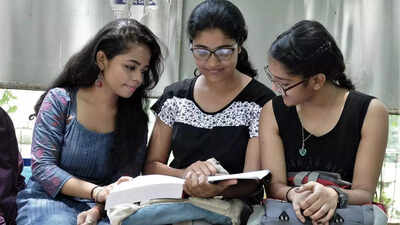
Several students who appeared for the exam described the paper as balanced but time-consuming.Tanishka, a student of Government Girls Senior Secondary School, Sonia Vihar, whose examination centre was Sarvodaya Kanya Vidyalaya, Khajoori Khas, said the paper was moderately difficult.

Do you think the new digital evaluation system will improve grading accuracy?
She said that Section D was quite tough and required lengthy calculations. Her classmate Komal, who appeared at the same centre, echoed a similar view, saying that Section D was definitely the hardest part. Both students noted that while the paper was not entirely unexpected, time management became important in the final hour of the exam.Across different schools, many students also said that the paper felt slightly lengthy. Some candidates mentioned that they completed the exam just in time due to the long calculations required in a few questions. Students Amish Gupta, Aryavir Bajaj, and Manthan Varshney also told TOI that they experienced time pressure during the exam despite being well prepared.
CBSE Class 12th Mathematics exam: Here’s what the paper pattern looks like
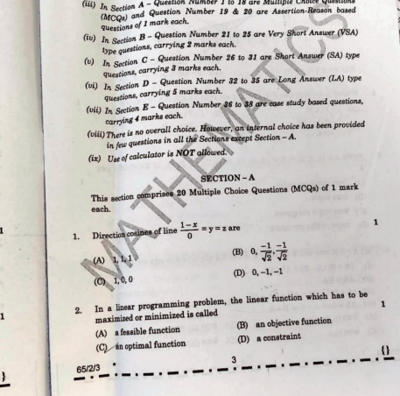
CBSE Class 12 Mathematics question paper was split into five parts, which were meant to measure a different level of conceptual knowledge and analytical skills.
- Section A: Multiple Choice Questions (MCQs).
- Section B: Short answer questions of a very short type.
- Section C: Short answer questions where short calculations are necessary.
- Section D: Long answer questions that require step-by-step answers that are detailed.
- Section E: Case study questions that involve the application of mathematics concepts to real life problems.
According to teachers, Sections A, B and C were mostly clear and aligned with the concepts covered in the syllabus. Many students said they were able to attempt these sections comfortably as the questions followed familiar patterns practiced during classroom preparation and revision.However, Section D contained a few questions that required careful interpretation and longer calculations. For example, one question on matrices that required application of concepts appeared slightly challenging for some students. Question 29(b) was described as comparatively lengthy and required multiple steps, which made it time-consuming. In Question 33(b), the instruction asking students to “find the differential” created some confusion in interpretation for a few candidates. Question 35(b) also appeared slightly complex as it involved a variable introduced within the expression, which increased the time needed to solve it.
Marking scheme: 80 marks theory, 20 marks internal assessment
CBSE Class 12 Mathematics Exam has a total of 100 marks. Among them, 80 marks are used in the written theory examination, which students took in the board exam.The other 20 marks are given by way of internal assessment, which is given by schools. This element usually covers periodic examination, assigns and general performance in the academic session.
Teachers share exam analysis
Pooja Nayyar, Head of the Mathematics Department at Seth Anandram Jaipuria School, Ghaziabad, said, “The difficulty level of the CBSE Class 12 Applied Mathematics paper was average. However, two questions appeared to be outside the syllabus. Question number 19 from Integration and question number 35 from Financial Mathematics were not aligned with the prescribed content. Apart from these, the rest of the paper followed the syllabus and students were able to complete it within the given time.”Shweta Choudhary, Educator for Senior Years at Shiv Nadar School, Faridabad, said, “The Applied Mathematics paper was manageable overall. Except for Question 19, which seemed outside the syllabus, most questions were within the expected scope. Question 35 required a longer response, but the remaining questions were straightforward.”Abraar Ahmed, Educator for Senior Years at Shiv Nadar School, Noida, said, “The Standard Mathematics paper was moderately lengthy. The one mark questions were direct and Section B was manageable. However, the case study questions were somewhat unexpected and some integration questions were lengthy. Many questions tested calculation skills more than conceptual understanding.”Nishant Kumar Singh, Subject Matter Expert at Seth M.R. Jaipuria Schools, said, “The question paper was well structured and followed the prescribed syllabus and exam pattern. It included objective questions, short answers, long answers and case study based questions. Sections A, B and C checked fundamental understanding and procedural clarity. Section D required students to combine multiple concepts, especially from topics such as matrices, probability, vectors and three dimensional geometry. Section E connected mathematics with real life situations and encouraged students to analyse information and apply concepts.”Vikram Singh, Head of the Mathematics Department at DPS Sector 45, Gurugram, said, “The paper was balanced and most questions were based on the NCERT syllabus. It tested both conceptual understanding and problem solving ability. None of the questions appeared outside the syllabus, and students who prepared well using NCERT would have found it accessible.”Dr Alka Kapur, Principal of Modern Public School, Shalimar Bagh, shared the exam analysis and said, “The difficulty level ranged from moderate to moderately challenging. The length of the paper and certain variations from the expected pattern made it slightly demanding. Students also pointed out a five mark question from the chapter on three dimensional geometry involving the two point form of the equation of a line, which is not directly covered in the NCERT textbook. This created some confusion for a few students. However, students with strong conceptual preparation were able to attempt the paper confidently.”Praneet Mungali, educationist and Trustee at the Sanskriti Group of Schools in Pune, said, “The overall difficulty level of the paper was moderate. Case based questions were straightforward for students who understood the concepts well. However, the multiple choice questions were slightly long and required proper solving rather than quick selection of answers, which made them time consuming.”Suneeti Sharma, PGT of Mathematics at Global Indian International School, Noida, said, “The Applied Mathematics paper focused on competency based assessment and tested students’ practical understanding of the concepts. The question paper was structured well and most students were able to complete it within the allotted time. Sections B and C were balanced and aligned with the syllabus, and many questions were similar to those practiced during preparation. A few questions in Section D and one case study question appeared slightly beyond the expected scope, which made them challenging for some students.”Akhilesh Kumar Tripathi, Head of the Mathematics Department at Global Indian International School, Noida, said, “The General Mathematics paper was balanced and structured into five sections. Most questions were based on standard concepts and NCERT patterns. A few questions across Sections A, B, C and D were slightly tricky and required careful reading and conceptual clarity. The case study questions in Section E were time consuming as students needed to understand the situation before solving.”Teachers from Silverline Prestige School, Ghaziabad, also shared their feedback. PGT Mathematicians Shivam Tyagi, Alok Das and Virendra Panchal said, “The Applied Mathematics paper was moderate in difficulty and focused on conceptual clarity and application of concepts. Questions were asked from topics such as matrices, determinants, numerical inequalities, linear programming, financial mathematics, derivatives and probability distributions. Most students who had practiced regularly were able to attempt the paper confidently.”They also said that the core Mathematics paper followed a similar pattern and was largely aligned with the NCERT textbook. “The paper included case based and application oriented questions that tested conceptual clarity. Some questions from integral calculus required careful calculations and step by step presentation,” they said.Ganesh N, PGT of Mathematics at JAIN International Residential School in Bengaluru, said, “Section A was moderate and required strong understanding of formulas and properties. Section B was approachable for average students. Section C appeared challenging because many questions were from the Integrals chapter. Section D was moderate and internal choices helped students manage the section. Case study questions required careful reading and comprehension.”Chinmay Sharma, PGT of Mathematics at the same school, said, “The Applied Mathematics paper was moderate in difficulty and focused on conceptual understanding and application. Sections A and B had straightforward questions, while Section C had some variations that required careful interpretation. Section D assessed analytical ability. However, Question 19 appeared outside the syllabus and a question involving exponential calculations required reference values that were not provided.”
Discover more from stock updates now
Subscribe to get the latest posts sent to your email.