Iran Israel War | Why does the Strait of Hormuz’s closure matter?

What is the significance of the strait?
The Strait of Hormuz, only 33 kilometres wide at its narrowest, lies between Iran, Oman, and the UAE. It is a vital route for oil and gas from Saudi Arabia, Qatar, Kuwait, Iraq, and Iran leaving the Persian Gulf to various destinations.
Follow | Israel-Iran war LIVE
Other important shipping chokepoints in the world include the natural Malacca Strait off Singapore through which almost the entire west-bound Chinese maritime trade takes place; the Bab-al-Mandab at the mouth of the Red Sea, which has come under Houthi influence; the artificial Suez Canal connecting Europe and Africa-Asia; the artificial Panama Canal linking the Pacific and Atlantic Oceans; and the straits of Bosphorus and Dardanelles connecting the Mediterranean and Black Sea via the Sea of Marmara, which are crucial not just for nations such as Romania but also for Russia.
While Egypt and Panama hold sovereignty over the Suez and Panama canals, respectively, Turkey has exclusive sovereign rights over the Bosphorus and Dardanelles straits. Nations such as Malaysia and Singapore, and Iran and Oman play a major role in securing the natural straits (Malacca and Hormuz) while not holding sovereignty over them. India has been building naval presence in the Andaman and Nicobar Islands with the strategic aim of gaining leverage over Chinese trade across the Malacca Strait.


What is the current situation?
Since February 28, when the U.S. and Israel attacked Iran, and Iran retaliated, ship traffic across the strait has reduced by some 95%. Nine ships have faced attacks in or near the strait. Shipping is a high-risk business and even small damages can prove costly to repair. Lloyds List Intelligence, a maritime information provider, estimates that some 600 ships are now stranded in the region. Some 250 are bulk carriers carrying loose cargo such as coal, ores, and grain. Others include some 200 oil tankers and 50 gas carriers.

Can countries just halt shipping lanes?
International law generally treats the seas as commons. Though territorial waters and exclusive economic zones are recognised, in general, laws and practices tend to be favourable towards free usage of all of the seas by merchant ships, and by naval ships for “innocent” passage.
In the past, Egypt has shut down the Suez Canal. Panama has not shut down its canal. No country can order the shutdown of the Straits of Hormuz and Malacca as its sovereign right. However, lack of security, emanating from threats and attacks, can make shippers wary of making the passage due to fears of loss of life and property.
As a result, insurance costs can balloon. In the current situation, insurance premiums have climbed 10-15 times on a case-by-case basis depending, among other factors, on whether a ship is affiliated with any of the belligerent parties. A rough estimate suggests that purchasing insurance for just one week of a ship transiting the strait would cost nearly as much as what the owner would normally pay for a year.
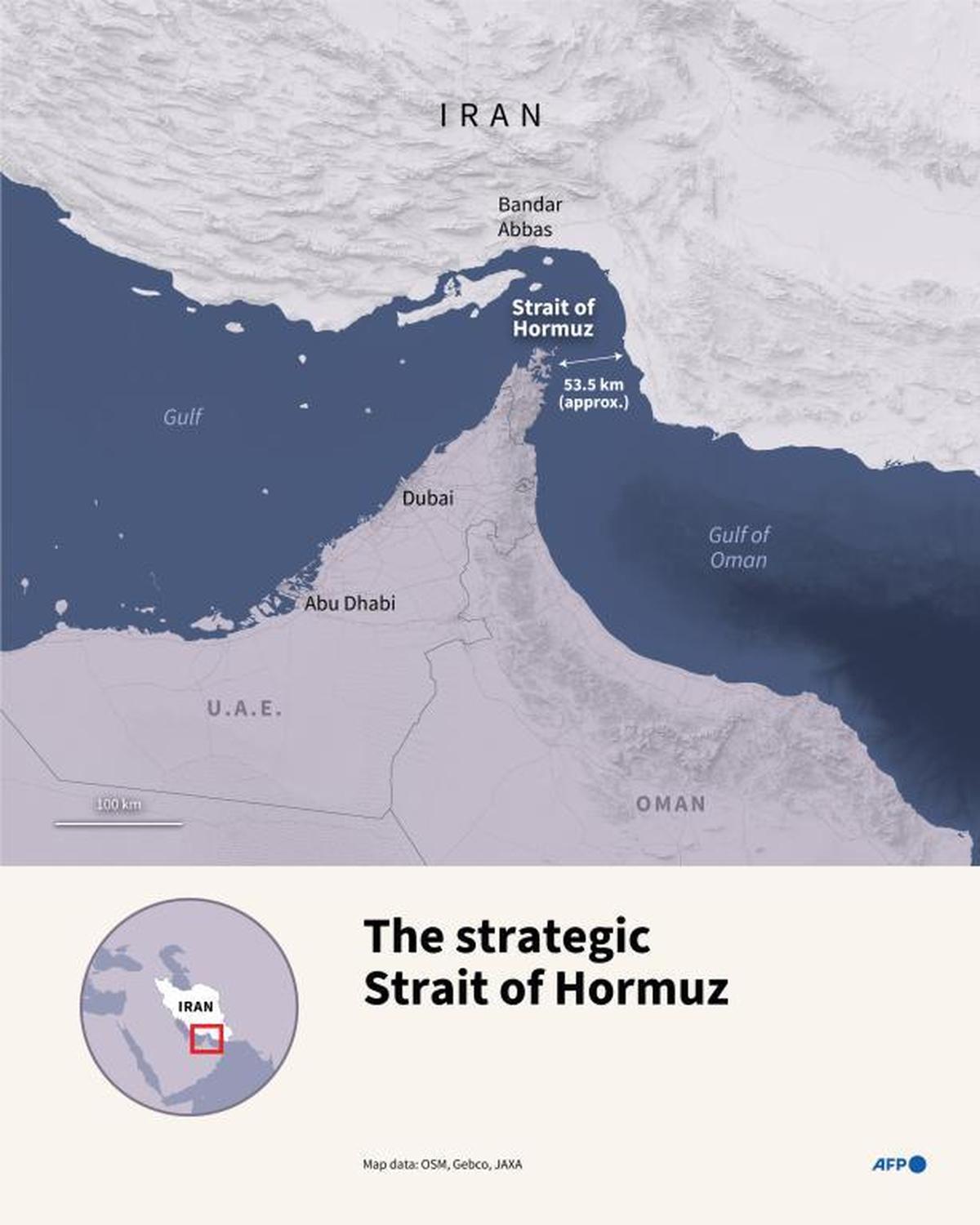
Map of the Strait of Hormuz, a vital chokepoint for global oil shipments linking the Gulf and the Gulf of Oman.
| Photo Credit:
AFP
Are there alternatives to this strait?
Saudi Arabia can transport fuels to its western ports on the Red Sea, such as Yanbu, through pipelines. However, ship traffic in the Red Sea plummeted when Houthi attacks started in 2023-24. In October 2023, for instance, there were around 2,300 ship transits across Bab-el-Mandab, the strait at the mouth of the Red Sea. By January, the number had dwindled to less than half of that. Since then, ship transits have only marginally gone up. Any attempt to leverage Red Sea ports may invite attacks from the Houthis, who are aligned to Iran.
How does closing the strait help Iran?
Iran has spoken in multiple voices over allowing ship passage. Currently, about one in five ships passing through the strait are Iranian. While those speaking for the Iranian government have said they would not like ship traffic to halt, agencies such as the Iranian Revolutionary Guards have threatened attacks. Iran hopes that closing the strait will force world opinion to bear upon Israel and the U.S. to end the conflict.
The strait is a leverage that Iran has historically exercised, such as during the Iran-Iraq war in the 1980s. At the time, the U.S. allowed merchant ships registered in other nations to fly its flag. This provided legal sanction for the U.S. to deploy its Navy to escort merchant ship convoys across the strait.
India’s response was unique then. Leveraging its neutrality and positive relationships in the region, the Shipping Corporation of India (SCI) had its ships painted ‘INDIA’ in big, bold white letters against the black hull so that the ships would be visible and stand out as belonging to India. Although there were attacks on SCI ships, the move did succeed to a large extent.
This time too, the U.S. President has vowed to keep ship traffic flowing through the strait. He has talked about escorting ships to provide direct security and also help defray insurance costs. India has been in touch with U.S. authorities for securing maritime insurance cover from the International Development Finance Corporation. The proposal had come from the U.S. government, officials have said.
Why the closure of Strait of Hormuz is causing fears about elevating crude oil prices
How does the situation affect India’s economy and oil prices?
Some 40% of India’s oil flows through the strait. Qatar supplies half of India’s liquefied natural gas (LNG) imports, which in turn provide half of the country’s natural gas needs. Qatar shut down its LNG production when the conflict began.
While LNG is regasified to supply city gas uses such as for cooking, power plants and other industrial uses, about 30% of India’s natural gas is directed towards fertilizer production. Though this is the off season for fertilizers, the situation may not recover fast enough when ammonia fertilizer demand picks up later this year. The government is actively pursuing other LNG sources, such as the U.S., Russia, and Australia.
Some 60% of India’s Liquified Petroleum Gas (LPG), which is mostly a mixture of propane and butane, comes from imports largely upstream of the strait. A shortage of LPG, the dominant cooking gas in India, is far more worrying. The government has come up with a series of measures, such as tweaking the oil refining process to produce more of propane-butane and prioritising cooking gas use of propane-butane.
The U.S. has given the green light for India’s purchase of Russian crude for 30 days, which is a relief. India has built supply networks with Russia and these will come in handy. Overall, Brent crude price has been hovering below $90 (it shot past $125 when Russia attacked Ukraine). In a reflection of the turn towards Russian oil, high sulphur Urals oil (from Russia) is now costlier than Brent oil in India. Increase in global crude prices may force the Indian government to increase administered price hikes in petrol and other fuels for transport and other uses, leading to a spiralling effect on the economy.
Published – March 08, 2026 05:05 am IST
Discover more from stock updates now
Subscribe to get the latest posts sent to your email.