




Automakers might start hiking prices to offset tariffs: Dealership exec
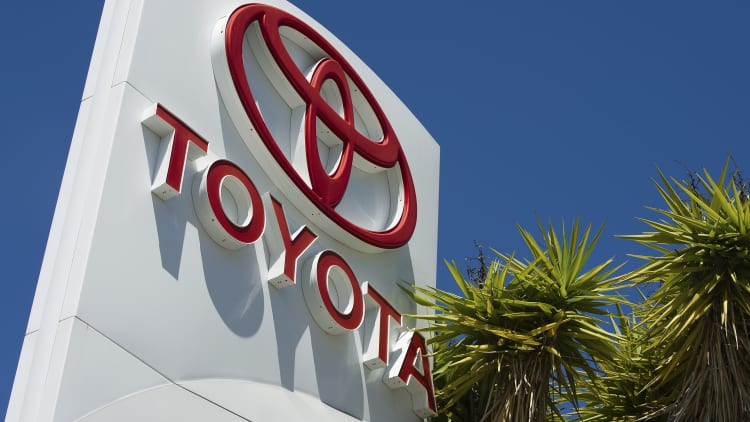

“The tariffs are too high on some of these brands, and they’re going to pass pricing on,” Sonic Automotive president Jeff Dyke said on the company’s fourth-quarter earnings call on Wednesday. “It’s already happening.”
It is unclear whether the auto industry will see any relief after the Supreme Court struck down some of the Trump administration’s so-called “reciprocal tariffs” on Friday. Some sector-specific tariffs are still in place, which means the auto industry will continue to face billions of dollars in tariff costs, depending on where an imported auto part or vehicle originates.
Toyota Motor told CNBC in an email that automakers are not affected by the tariffs imposed under the International Emergency Economic Powers Act, or IEEPA, which the court struck down Friday.
“The Supreme Court’s ruling on IEEPA-related tariffs does not affect existing tariffs imposed under Section 232,” Toyota wrote. “We are eager to see a renegotiated USMCA [United States-Mexico-Canada Agreement] that strengthens North American competitiveness and delivers greater certainty for the industry.”

Prices
Raquel Cunha | Reuters
So far, prices have not risen dramatically since the Trump administration began levying tariffs on imports from North American trading partners Mexico and Canada, and on vehicles and parts imported from other countries, industry experts said. Vehicle prices across the board have only risen about 1% or so, nothing like the price spikes seen a few years ago during and after the pandemic, said Jessica Caldwell, an analyst for Edmunds.
“The evidence that we have seen is relatively minimal compared to what we thought in the beginning when tariffs were announced,” Caldwell said.
Shoppers have reacted though, she said.
“We saw a massive spike on our side on Edmunds for new shoppers looking at used [vehicles], because I think the assumption was that all of a sudden now new vehicles are going to become super expensive,” she said. “And that has stayed elevated through today.”
She said she has seen evidence of some higher pricing on certain models — such as higher-end vehicles, which are sold to buyers that might be less price sensitive. She added that she can’t be sure those increases are due to tariffs, but that might be one way automakers blunt the effects without raising prices across the board.
“It doesn’t really look like incentives are necessarily taking a big hit either,” she said. “I thought that would be the first one to go.”
Caldwell added that there has been some price flexibility in the market, and that across a large automakers, there can be a lot of relatively inexpensive vehicles.
But Dyke’s comments indicated broader price hikes could be on the horizon.
“The affordability issue, while maybe not being felt in 2025, we believe as you get into May, June, July, August, you’re going to start feeling it as new car prices have nowhere to go but up,” he said on the call.
“They’re not going to sit back and lose billions and billions of dollars,” he added. “They can’t. It’s just not going to happen.”
Toyota
Tariffs have hit major automakers across the board. American ones, such as Ford and General Motors paid out billions in 2025, and have said they expect to again this year.
Toyota, the world’s largest automaker by volume, saw net income fall 25% in the first nine months of its fiscal year 2026, according to a filing. Tariffs were a major driver — costing the company about 1.2 trillion yen, or roughly $8 billion.
Toyota told CNBC in an email that the tariffs are “highly disruptive” and “cannot be sustained.” The company has 11 U.S. factories — one co-owned with Mazda — where it built about 55% of the vehicles it sold in the country in 2025.
But many of the company’s popular and profitable models are made elsewhere. Its Tacoma midsize pickup truck is made in Mexico. Every Lexus model, except the TX SUV, is made either in Canada or Japan. Both the Lexus brand and the Tacoma sold in record numbers in the U.S. in 2025.
Toyota also told CNBC that its U.S. factories, which made nearly 1.4 million cars last year, are running at full capacity.
Tacoma is Toyota’s “weak spot” said Sam Fiorani, vice president of forecasting for AutoForecast Solutions.
“If they wanted to limit some more exposure, they would relocate some of that production to the U.S.,” he said. “The problem is they just don’t have the space to do it.”
Moving other vehicle production back to the U.S. is possible, he added. Lexus, for example, shares some underpinnings with Toyota brand vehicles made in Kentucky and Indiana.
But the company is likely waiting for the outcome of trade talks between the U.S., Mexico, and Canada, Fiorani said. The deadline for a decision on a trade agreement between the three countries is set for July.
“Once they see what the landscape is after July, then they can make a decision to say, ‘It’s worth our time to build a new plant in Texas, to build Tacomas or expand the output in Kentucky or Indiana to build Lexus,'” he said.
Discover more from stock updates now
Subscribe to get the latest posts sent to your email.

