The curious case of the star that may have swallowed itself

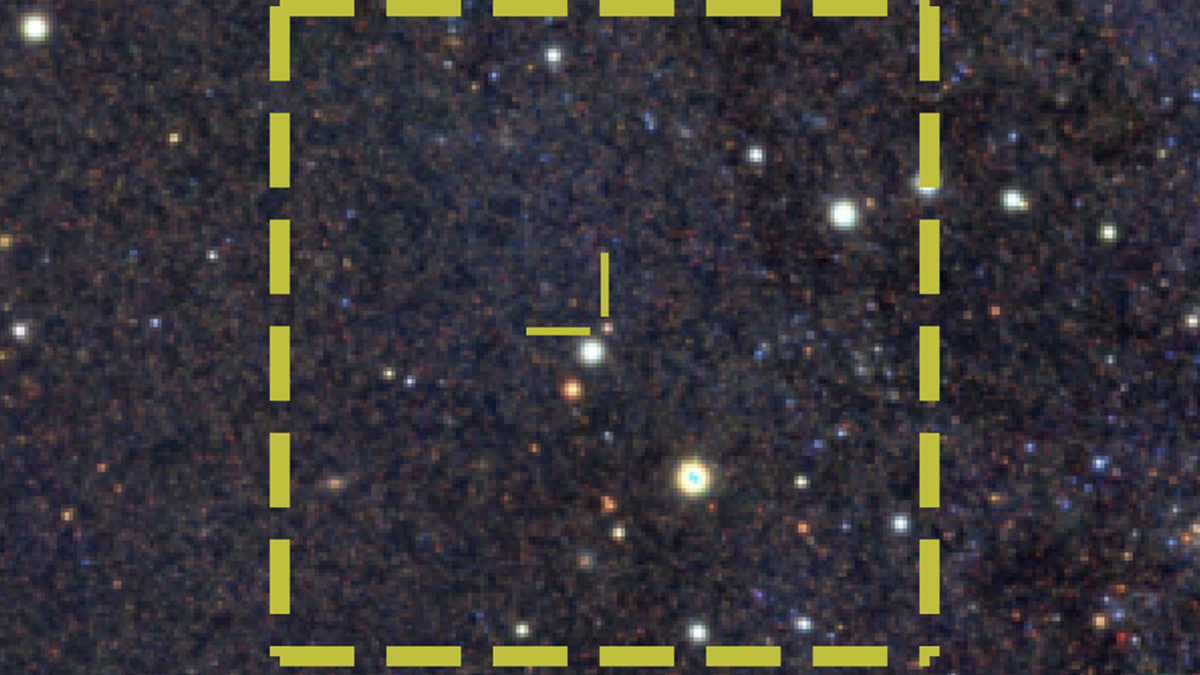
An optical colour composite image of the viewing field taken from the PanSTARRS survey. The yellow cross-hair indicates the position of the star.
| Photo Credit: DOI: 10.1126/science.adt485
In a recent paper in Science, astronomers have reported observational evidence of such a star in the Andromeda Galaxy, dubbed M31-2014-DS1.

The star was a supergiant about 100,000-times brighter than the sun. In 2014, it brightened in infrared light, suggesting dust was forming around the star. Then, from 2017, the star’s brightness dropped by more than 10,000-times over five years until, in 2023, optical telescopes couldn’t see it.
The researchers, led by Kishalay De from Columbia University, analysed years of archival data as well as made new observations using some of the world’s most powerful telescopes, measuring the star’s brightness in different wavelengths. They also built computer models of how stars evolve and die to help them understand the star’s properties.
All the evidence indicated a failed supernova. When the star’s core collapsed, it should have sent a powerful shockwave through the star’s outer layers, blasting them into space. However, the wave may not have been powerful enough, causing most of the star’s material to fall back to the collapsing core.

As a result, the star would have ‘swallowed itself’, leaving behind a black hole. The infrared brightening in 2014 was likely caused by the small amount of material that was ejected; this material would have subsequently cooled and formed dust, which would have glowed with infrared light before eventually dispersing.
The researchers also found similarities with another candidate named NGC 6946-BH1, which vanished from optical telescopes’ view in 2009, suggesting ‘failed supernovae’ may not be as rare as astronomers once believed. At the same time, the researchers wrote in their paper, the relationship between a star’s mass and how it dies may also be less predictable than first thought.
This said, a separate group led by Emma Beasor of Liverpool John Moores University argued in early January that the observations don’t exactly match a failed supernova, including that the erstwhile star’s infrared brightness didn’t fade as expected. Instead, this group suggested the data could also be explained by two stars colliding and merging.
At present, Dr. De said in a podcast, the team will keep studying the star to learn more.
mukunth.v@thehindu.co.in
Published – February 18, 2026 08:00 pm IST
Discover more from stock updates now
Subscribe to get the latest posts sent to your email.