


Not just humans, apes can imagine, pretend and mentally track things that aren’t real, study finds |
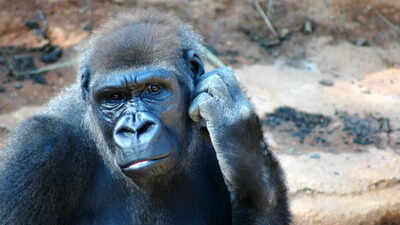
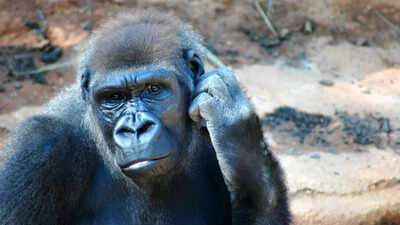
For decades, imagination was treated as a uniquely human trait, the mental ability to picture objects, events, or scenarios that do not physically exist. From storytelling and pretend play to abstract planning, this capacity was seen as a defining line separating humans from other animals. A new scientific study is now challenging that long-held belief and suggests that at least some apes are capable of imaginative thought as well.In carefully designed experiments, researchers found that great apes can pretend, track invisible objects, and distinguish imagined scenarios from real ones. The findings indicate that apes are not limited to reacting only to what is directly in front of them. Instead, their minds can represent absent or fictional elements, a cognitive skill once thought to be exclusive to humans. The research opens new questions about how imagination evolved and how much humans truly share with their closest living relatives.
How scientists test imagination in apes

The study was led by scientists at Johns Hopkins University and published in the peer-reviewed journal Science. Researchers designed tasks to test whether apes could mentally represent objects that were not physically present, rather than simply responding to trained cues or routines.Unlike earlier anecdotal observations of animal pretend play, these experiments were controlled and repeatable, allowing scientists to rule out simple conditioning or guesswork.A key participant in the study was Kanzi, a bonobo well known for his involvement in language and cognition research. In one experiment, researchers pretended to pour invisible liquid into cups and then moved the cups around. Kanzi was asked to indicate where the imaginary liquid was located.He consistently tracked the pretend liquid even after the containers were rearranged, suggesting he was mentally following something that did not physically exist.
Knowing the difference between real and imagined
Crucially, the apes were not confused about reality. When given a choice between a real reward and an imaginary one, Kanzi overwhelmingly chose the real option. This showed that he was not mistaking imagination for reality, but instead understood the difference between the two, a key requirement for genuine pretend cognition.This distinction strengthens the argument that apes are capable of imagination rather than simple imitation or learned behaviour.The findings challenge a core assumption in cognitive science, that imagination marks a sharp boundary between humans and other animals. Instead, the research suggests imagination may have evolutionary roots and may be shared to some degree with other great apes.Scientists say this does not mean apes imagine in the same complex ways humans do, such as writing fiction or planning decades ahead. However, it does indicate that the foundations of imagination, mentally representing the unseen, may have emerged long before modern humans.
Rethinking what makes humans unique
The study adds to growing evidence that many cognitive abilities once thought uniquely human, including tool use, empathy, communication, and now imagination, exist in simpler forms among other species. Rather than a sudden leap, human cognition may represent an expansion of abilities already present in our evolutionary past.
Discover more from stock updates now
Subscribe to get the latest posts sent to your email.