


“I changed my major and now I feel dumb,” writes a student: What to do when you second-guess your degree choice


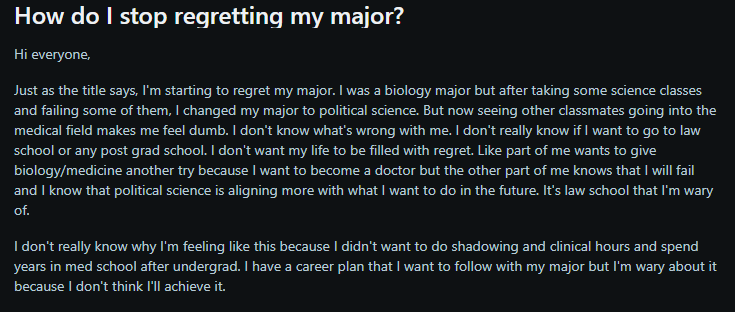
There is a predictable point in every academic year when self-doubt rises. It often arrives when classmates begin announcing medical school admits, competitive exam ranks or high-profile internships. In that atmosphere, even a thoughtful academic decision can begin to feel like a mistake.A recent Reddit post captures this anxiety with striking honesty. “I was a biology major but after taking some science classes and failing some of them, I changed my major to political science. But now seeing other classmates going into the medical field makes me feel dumb.” The student describes feeling split: “Part of me wants to give biology/medicine another try because I want to become a doctor but the other part of me knows that I will fail.” They also admit that political science aligns more closely with their long-term goals, though law school brings its own uncertainty. The fear at the centre of it all is clear: “I don’t want my life to be filled with regret.”This internal tug-of-war is not unusual. In fact, it reflects a pattern documented across higher education systems.
Changing majors is more common than students think

Data from the U.S. National Center for Education Statistics, based on its Beginning Postsecondary Students Longitudinal Study, shows that roughly 30 percent of bachelor’s degree students change their major at least once within three years of enrolling. Students who begin in STEM disciplines, including biological sciences, are statistically more likely to switch than those in non-STEM fields.This means that moving away from biology after struggling in early science courses is not an isolated event. Introductory STEM classes often function as academic filters, and many students reassess their interests and strengths during this period.
The power of comparison
One commenter responding to the Reddit post noted, “It’s super common to feel this regret wave when you see classmates grinding toward med school. Social media and campus vibes make it look like that’s the only ‘successful’ path.” The same commenter pointed out that the student already knew why they switched: “the science grind wasn’t for you, the long med-school haul didn’t excite you, and political science actually lines up with what you want long-term.”Psychologists have long studied this phenomenon. In the 1950s, social psychologist Leon Festinger proposed social comparison theory, arguing that individuals evaluate their abilities and decisions relative to those around them. On competitive campuses, where medicine and engineering often dominate conversations about success, stepping away from those paths can feel like personal failure, even when the decision reflects self-awareness.Comparison magnifies doubt. It does not necessarily reflect reality.
Failure is feedback, not identity
The Reddit student connects failed science classes with a sense of inadequacy. That leap is common among high-achieving students who are unaccustomed to academic setbacks.Research led by psychologist Carol Dweck at Stanford University on what she termed “growth mindset” shows that students who believe abilities can be developed through effort and strategy are more likely to persist after setbacks. Those who see intelligence as fixed are more likely to interpret a single poor performance as a permanent verdict.This does not mean every student who persists in a difficult major will eventually thrive in it. It does mean that one semester of struggle should not be treated as a lifelong label.
Alignment matters more than prestige
One of the most revealing lines in the Reddit post is this: “I didn’t want to do shadowing and clinical hours and spend years in med school after undergrad.” That statement suggests the hesitation may not be about ability alone, but about lifestyle fit.Large-scale surveys support the importance of alignment. The Gallup-Purdue Index, which studied tens of thousands of graduates, found that long-term wellbeing and engagement were more strongly associated with meaningful work and supportive academic experiences than with the specific major or institutional prestige.In practical terms, satisfaction depends less on whether the degree says biology or political science and more on whether the daily work connected to that degree feels purposeful.
Evaluating the advice
The Reddit responses reflect three common reactions students hear.One commenter framed the doubt as social pressure. Another suggested stepping away from university altogether to reconsider direction, even proposing structured alternatives such as the military. Research from the National Student Clearinghouse shows that students who “stop out” without a clear re-enrolment plan face a higher risk of not completing their degree. Pausing education can be constructive when intentional, but risky when driven by panic.A third commenter proposed combining interests: “If you like political science, why not keep it as your major and be pre-med? Best of both worlds.” While this path is academically possible in many institutions, it requires careful workload planning and genuine interest in demanding science coursework. It should be chosen out of conviction, not indecision.
From regret to reflection
Students caught between paths benefit from replacing speculation with evidence.Structured career counselling can help clarify interests and values. Short-term internships or shadowing experiences provide real exposure to daily work life. Honest self-assessment can separate fear of failure from lack of interest.The belief that one undergraduate choice permanently fixes a career no longer reflects modern labour markets. Career trajectories today are increasingly non-linear, and transferable skills such as analytical reasoning, communication and problem-solving often matter more than the title of a major.The Reddit student’s closing worry remains deeply human: “I don’t want my life to be filled with regret.” Regret tends to grow when decisions feel rushed or reactive. It shrinks when choices are examined carefully, tested through experience and grounded in self-knowledge rather than comparison.A major is an academic foundation. It is not a life sentence.
Discover more from stock updates now
Subscribe to get the latest posts sent to your email.