




Union Budget 2026 does little to reduce out-of-pocket expenses, medical inflation: experts


Former president of the Indian Medical Association (IMA) Ravi Wankhedkar criticised the continued focus on pharmaceuticals and AYUSH at the cost of primary healthcare and public health infrastructure, warning that allocation to medical tourism initiatives would largely benefit corporate hospitals rather than ordinary citizens. “Adjusted for inflation,’’ Dr. Wankhedkar said, “health spending has effectively declined, with paramedical training emerging as the lone long-term positive.”

The Working Group on Access to Medicines and Treatment in its statement said the Budget brings in two measures for patient relief. First, it eliminated basic customs duty (BCD) on 17 cancer medicines. Second, it extended import duty exemptions to seven additional rare diseases for personal imports of drugs, medicines, and Food for Special Medical Purposes.


“This is the third consecutive budget announcing BCD eliminations. In 2024, the BCD exemption covered three cancer medicines of British-Swedish pharmaceutical company AstraZeneca. In 2025, the budget expanded this to 36 medicines for cancer and rare diseases. Later, 37 more medicines and 13 patient assistance programmes were added. The BCD exemption will deliver minimal benefit to patients. Since the maximum retail prices of these medicines remain unaffordable for most Indians even after the BCD exemption. Only a fraction of the population with access to huge finance or schemes like CGHS can afford them,’’ it said.
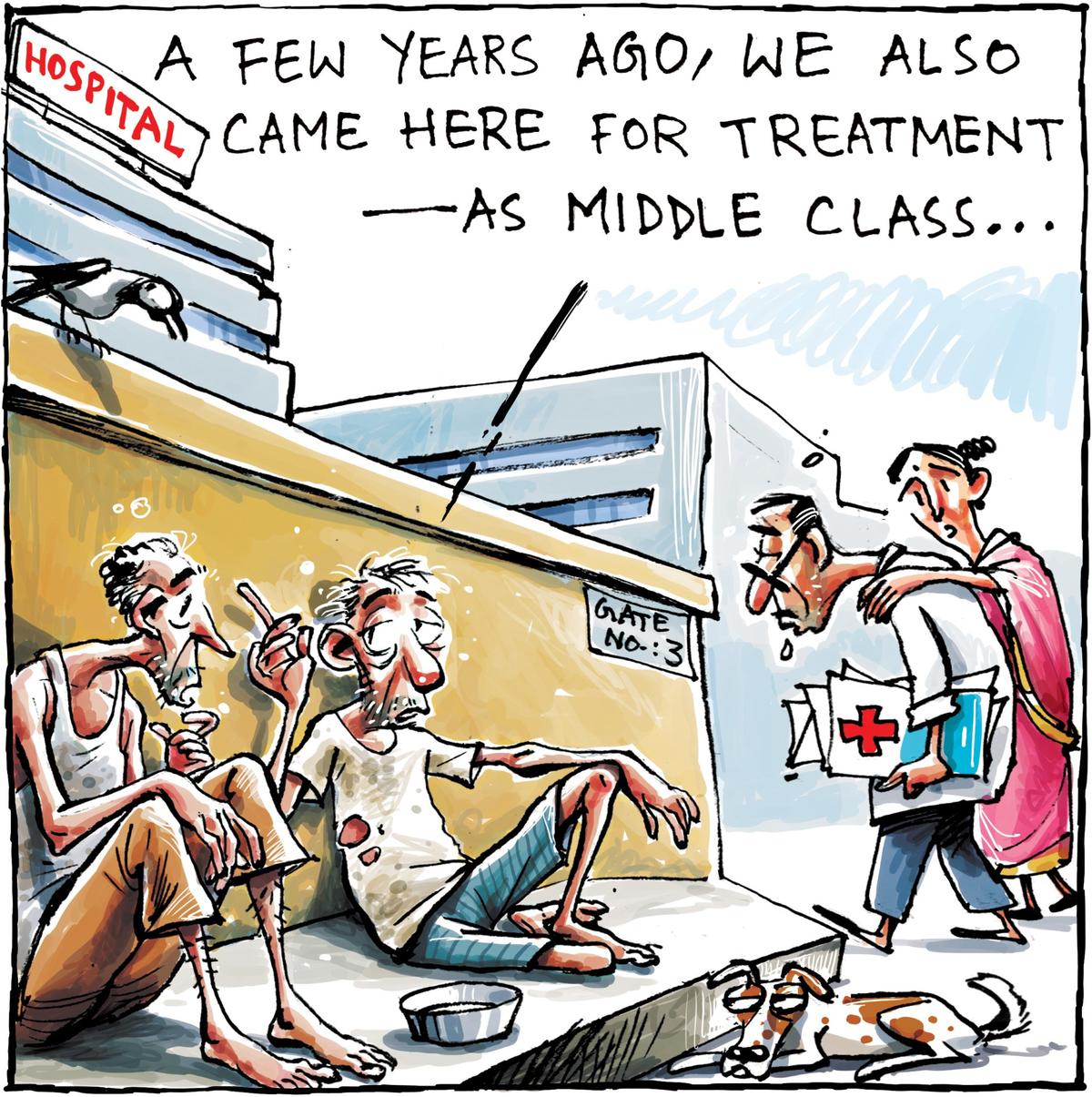
Illustration: Soumyadip Sinha
It said there is no evidence that companies reduced prices in response to the BCD waiver.
“The companies are not passing the benefit of lowering of price to the patients and hence, the waiver is benefitting the foreign multinationals, not the Indian patients. Intellectual Property monopolies, especially patent monopolies are the key drivers of exorbitant prices in India. Rather than deploying available legal tools under the Patents Act like government use licence, compulsory licence and stricter scrutiny of secondary patents and improving the drug regulatory framework including streamlining approval pathway for quality assured generics and biosimilars, the government relies on BCD exemption on selected drugs,’’ it added.

Stating that the Budget has looked at healthcare as an economic responsibility, Sanjaya Mariwala, MD, OmniActive Health Technologies, said that infrastructure expansion will work only if doctors are properly incentivised to set up and run hospitals. “Large Indian companies should also be encouraged to partner with hospitals and expand care networks, especially beyond metros,’’ he said, adding that the push on AYUSH and Ayurveda is timely.

Director, All India Institute of Ayurveda (AIIA), Goa, P.K. Prajapati said that the opening of the AIIA institutes will strengthen quality education, research and patient care in ayurveda.
“The renewed focus on skill development, healthcare training and allied services, along with the upgradation of AYUSH pharmacies and drug-testing laboratories to higher standards, will significantly enhance the quality, safety and credibility of Ayurveda and other AYUSH medicines,’’ said Ajay Sharma, director, Shree Baidyanath Ayurved Bhawan Pvt. Ltd.
Welcoming the government’s emphasis on strengthening Central Drugs Standard Control Organisation and advancing a more predictable, science-led regulatory framework as a welcome move, Winselow Tucker, president Eli Lilly and Company (India), said that aligning regulatory processes with global standards — while expanding India’s clinical research capabilities — will help bring medical innovation to India faster, improve timely patient access to new therapies, and reinforce India’s position as a trusted global life-sciences hub.
Sameer Bhati, public health analyst, said that the proposed creation of medical tourism hubs and regional medical centres will upgrade infrastructure that benefits both international patients and citizens, easing pressure on metro hospitals. “Equally critical is the focus on mental health programmes and allied health professional institutes, which will expand counselling access, reduce stigma, and generate skilled healthcare jobs, particularly in geriatrics, ensuring comprehensive, community-centric care for India’s evolving health needs,’’ he said.
Published – February 01, 2026 09:45 pm IST
Discover more from stock updates now
Subscribe to get the latest posts sent to your email.
