


IIT-Delhi, Germany team makes device to sort current by ‘handedness’

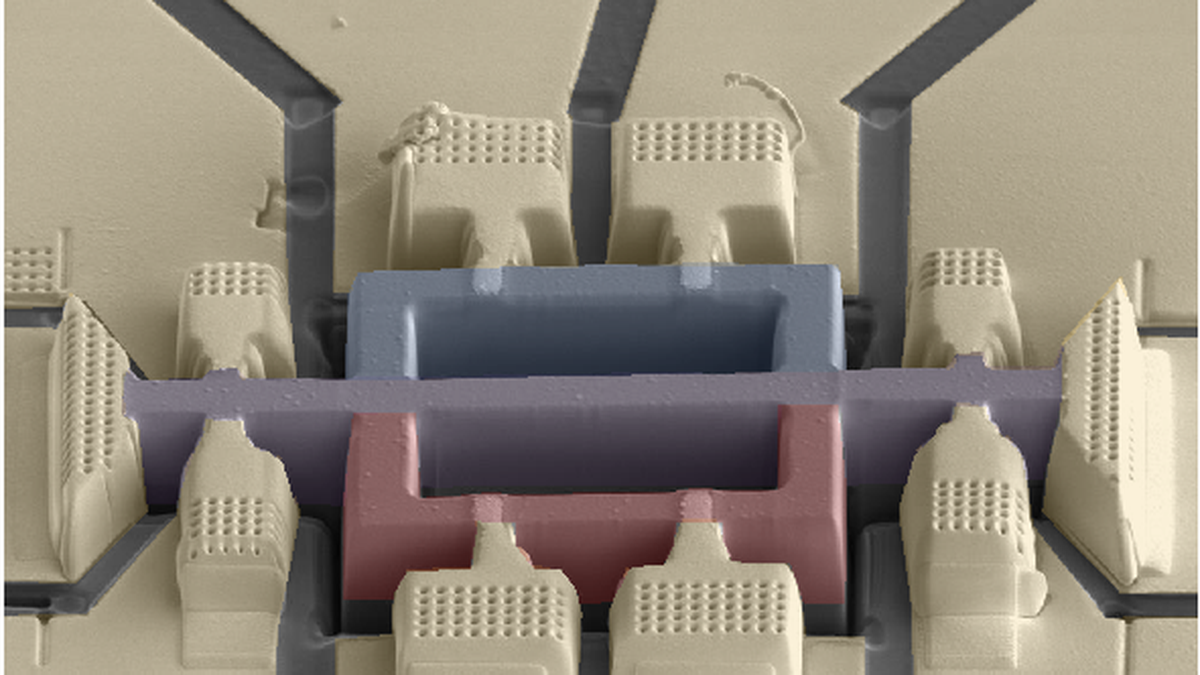
False-coloured SEM image of the microstructured device of PdGa made using focused-ion beam techniques, showing the three-arm geometry. The scale bar is 10 μm.
| Photo Credit: Dixit, A., Sivakumar, P.K., Manna, K. et al. Nature 649, 47–52 (2026)
The human left hand is a mirror image of the right; the two can’t be perfectly superimposed. In certain complex materials called topological semimetals, electrons possess a similar left or right chirality. (The chirality is a specific quantum state of an electron moving inside the crystal.)

However, these special electrons are usually mixed with ‘standard’ electrons that lack chirality and detecting them has historically required the use of powerful magnetic fields or precise chemical doping, rendering the technology impractical for daily use. The researchers addressed this challenge by exploiting the quantum geometry of a palladium gallium (PdGa) crystal.
“The single homochiral crystal made by Claudia’s group was crucial for the study,” Max Planck Institute of Microstructure Physics managing director and study co-author Stuart Parkin told The Hindu, referring to the work of fellow author Claudia Felser.
In this crystal, electrons behave like waves as they move through the lattice, which in turn restricts how much energy and momentum the wave can have.
The set of constraints is called the band structure — like a road an electron travels on. In the copper wiring in your house, the road is flat and straight. If you apply a voltage, it will push the electron in a straight line. In the crystal, the road is twisted, so even if the electron is moving straight, its path will drift to the side. Which side depends on the electron’s handedness.
The team fabricated a small device with three arms and passed an electric current through it. Beyond a threshold, PdGa’s quantum geometry pushed left-handed electrons into one arm and right-handed electrons into the other.

“Utilising quantum geometry as a new functional element, rather than an external magnetic field, was pivotal to achieving the valve functionality,” Dr. Parkin said. “It led us to fabricate our unique device geometry to demonstrate that we can control the separation of currents with opposite electronic chirality.”
Some roadblocks remain, including the need for ion beams to fabricate the device and ultra-low temperature to operate it, which make practical use infeasible. If these challenges can be overcome, the technology could lead to low-power computing and new forms of magnetic memory.
mukunth.v@thehindu.co.in
Published – February 09, 2026 10:00 am IST
Discover more from stock updates now
Subscribe to get the latest posts sent to your email.