



What Ford and Ram replaced their EV pickups with
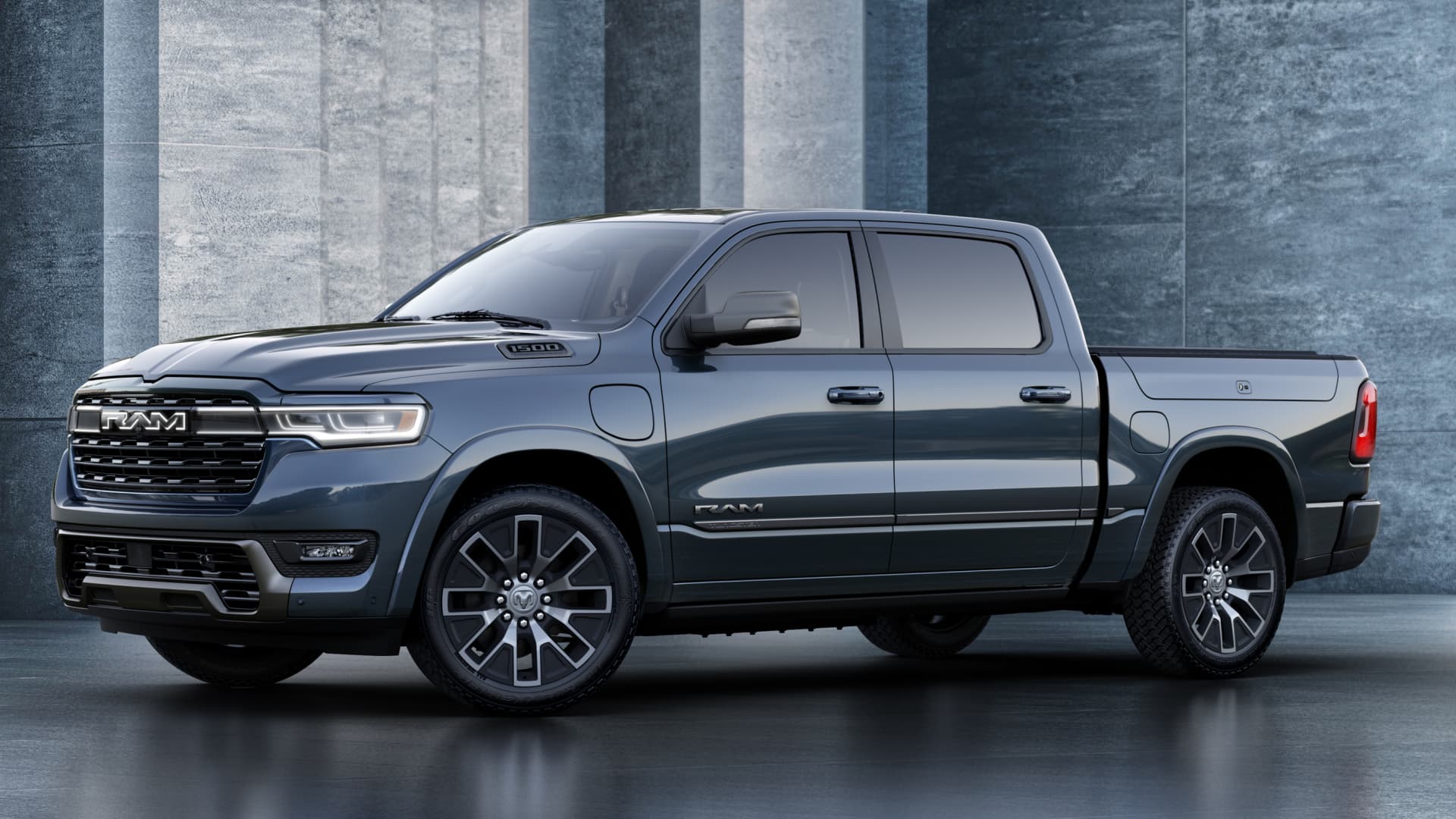
Now, companies are pivoting to extended-range electric vehicles, or EREVs. Ford and Stellantis‘ Ram, as well as newcomer Scout Motors are scheduled to start delivering EREV models through 2027.
“I’ll say it’s a game changer, even a segment-buster in the pickup world,” said Douglas Killian, chief vehicle synthesis manager at Ram.
An EREV — or REEV, as Ram calls it — is a “series hybrid.” On most hybrid vehicles, both the gas-burning engine and battery-powered motors drive the wheels. On a series hybrid, the engine only charges the battery.
The battery is much larger than those on most hybrids, leading to longer range. Both the Ram and Scout EREVs are expected to get about 150 miles of EV-only driving before the gas generator kicks on.
“I’m a pickup guy,” Killian said. “We appreciate the electric drive experience. … [But] you may have a need to go somewhere farther. You may want to take the same electric vehi cle on a vacation and not wait for the truck to charge all the time.”

A couple of series hybrid models have been released in America over the past 20 years, such as the Fisker Karma in 2010 and the BMW i3 EV. But American automakers think it’s the right move for the U.S. truck market.
Part of their enthusiasm comes from the segment booming elsewhere, like in China. In just one year, the number of EREV models worldwide jumped 40%, according to a report by the International Energy Agency, almost entirely due to growth in China.
The models seem to be especially popular in places where EV range and charging times may be greater concerns.
A McKinsey survey published in early 2025 found that somewhere between 13% to 18% of car buyers in Germany, the UK and the U.S. would consider an EREV over an internal combustion, plug-in hybrid or an EV if given the option. The U.S. had the highest level of interest at 18%, with the biggest share taken away from internal combustion and hybrid vehicles.
It might be a way for someone interested in EVs to try out owning a vehicle without having to commit fully, said Paul Hackert, senior expert and associate partner at McKinsey & Company.
“These potential EREV buyers are interested in faster charging, a total longer driving range, being electric without being 100% dependent on having to get their vehicle charged when they’re low on battery charge,” Hackert said.
Truck buyers are different
Scout has both full-EV and EREV versions of its pickup and SUV models, but so far more than 80% of the customer reservations are for the EREV version, called the Harvester, he said.
“I think for a lot of pickup buyers … their psychology is EV-only isn’t the best powertrain choice for a hard-working vehicle owner and buyer,” Decker said.
Loading up a truck bed can knock down battery range by a quarter and towing can drop it by half, studies have shown. That was part of the reason that Ram dropped plans for a full-size EV pickup, Killian said.
Take Ford. The Ford F-150 is the most popular pickup line in America, selling close to a million units in the U.S. The Lightning sold about 90,000 — about 3% of the total.
“You could argue 90,000 units for the whole EV pickup truck market was not a bad start. But that market clearly is a finite market to go with,” said Itay Michaeli, an auto industry analyst at TD Cowen. “The fundamental issue with a pure electric pickup trucks is, because of the weight and aerodynamics, you need a very, very large battery to achieve the desired range, particularly if the truck is being used for work.”
Greater market potential
If you measure range mile for mile, an EREV will have a lower upfront cost than a full EV with comparable range since an EREV has a smaller battery, said Stephanie Valdez Streaty, executive analyst at Cox Automotive.
“The bigger the vehicle, the bigger the battery, the bigger the cost,” she said.
EREVs do have much larger batteries than typical plug-ins, but they come with longer driving ranges. Typical hybrids in the U.S. max out around 40 miles or 50 miles, while the Ram and Scout EREVs promises about 145 miles of range just on EV power alone.
“We have way more all-electric range than a plug-in hybrid that’s in the market today,” Scout’s Decker said. “That’s why we’re expecting our EV utilization factor, the percentage of customers who will actually drive this in EV-only mode, will be significantly higher than a plug-in hybrid.”
So far, Ram’s EREV will be first to market, arriving in late 2026. Scout is beginning production in 2027, in a factory it has been building in South Carolina. Ford has not yet said when it will launch its model.
Scout said its EREV will start below $60,000. RAM has not released pricing information yet.
Not everyone is diving in.
General Motors has no EREV in the U.S., although CEO Mary Barra has said the company is considering adding some kind of plug-in hybrid to its lineup. Rivian CEO RJ Scaringe said on the company’s third-quarter earnings call that it has no plans to make an EREV.
EREVs also have their critics. European advocacy group Transport & Environment said in a recent report that EREVs have some technical advantages over other types of plug-in hybrids, but can still emit as much pollution as an ordinary gas-burning vehicle. It is also possible to drive it without ever charging it.
They could be more costly to build.
“From a manufacturing perspective, with the pure battery, it’s simpler, fewer parts,” Valdez Streaty said.
“When you start adding different things, it just gets more complicated. … But they’ll figure it out and they’ll continue to find efficiencies, make it more cost-effective.”
The greater complexity will also require an owner to maintain it more like a gas vehicle, which nullifies a one of the most-cited benefits of EV ownership. But owners have the added safety of a backup plan.
“It’s one of these situations where we’re all saying, ‘What’s the catch?'” Killian said. “To a customer, there really is not a catch.”
Watch the video to learn more.
Discover more from stock updates now
Subscribe to get the latest posts sent to your email.