India-U.S. deal raises hopes for a reset — but the fine print remains unclear
But the lack of detail and a clear timeline has fueled doubts over how quickly the framework can be turned into a binding agreement and whether the two nations can move beyond tensions from last year.
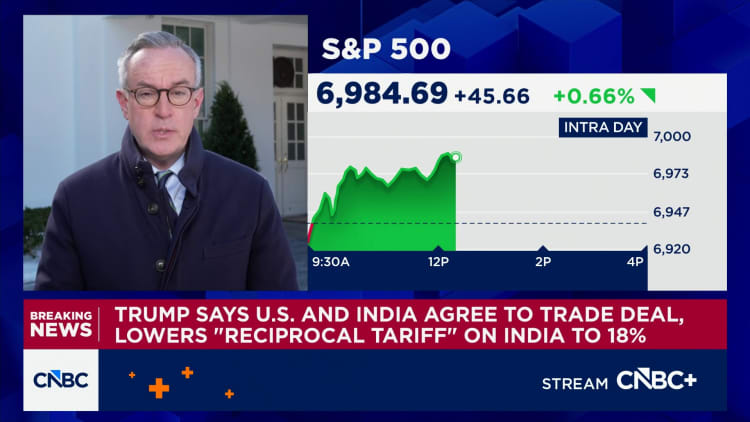
President Donald Trump said the U.S. would lower reciprocal tariffs on India to 18% from 25% after Prime Minister Narendra Modi agreed to stop buying Russian oil. Washington would also reportedly waive an additional 25% tariffs slapped on New Delhi for its oil purchases.
India would, in turn, reduce its tariffs and non-tariff barriers on U.S. goods to zero while pledging to buy $500 billion of U.S. products, Trump said, without giving further details on the timeline or sector commitments.
Modi confirmed the new 18% tariff rate in a post on X, calling the agreement a step towards restoring stability and momentum in bilateral ties.
“I look forward to working closely with [President Trump] to take our partnership to unprecedented heights,” Modi said. But the Indian leader did not mention Russian oil or Trump’s claim that India would eliminate its levies on American goods.

Relations between the longtime partners soured rapidly during Trump’s second term after he claimed to have mediated an end to India’s conflict with Pakistan in May, a characterization New Delhi rejected. Tensions also deepened after Washington slapped additional tariffs over India’s purchases of Russian oil while sparing China, the largest importer of Russian energy.
“[The] devil is in the details. I have a hard time believing the government of India is going to make any Russian oil-related commitment explicit,” said Evan Feigenbaum, vice president for studies at the Carnegie Endowment for International Peace.
Feigenbaum was also skeptical of India’s push to reach the $500 billion target, calling it “kind of a stretch.” But U.S.-India trade has “undershot its potential forever, so ambition is good,” Feigenbaum said.
The U.S. has remained India’s largest trading partner and a key partner in defense, technology and advanced manufacturing.
Total goods and services trade between the two countries rose over 8% to $212.3 billion in 2024, U.S. official data showed. U.S. goods exports to India rose 3% to $41.5 billion in 2024, while services exports surged 16% to $41.8 billion from the previous year.
Strategic reset
The new 18% rate would be slightly more favorable than the rates imposed on Pakistan, which faces a 19% tariff, as well as the 20% levies for Vietnam and Bangladesh, major regional competitors in manufacturing.
“This trade deal is just what the doctor ordered: a confidence-building measure that can help the two sides work through their various issues — including all the trust that the Trump administration has squandered in New Delhi in recent months,” said Mark Linscott, a senior fellow on India at the Atlantic Council and former U.S. trade official.
Most of the deals that Trump struck with trading partners remain frameworks, with few details and uncertain implementation timelines. Legal questions also remain over whether the president has the authority finalize binding trade deals without congressional approval.
“I hope to see the implementation of this deal. But beyond that, the two sides should be entering into the next phase of negotiations and taking up a broader set of issues,” Linscott said, particularly on areas like economic security, technical barriers to trade, digital trade and intellectual property rights.
Indian Prime Minster Narendra Modi and U.S. President Donald Trump raise clasped hands onstage at NRG Stadium during a rally on Sept. 22, 2019 in Houston, Texas.
Sergio Flores | Getty Images News | Getty Images
The timing of the U.S.-India deal came one week after New Delhi finalized a sweeping free trade agreement with the European Union, a move analysts say added urgency to talks with Washington.
While the EU deal lifted some pressure on New Delhi by providing an alternative Western economic anchor amid global tariff volatility, the U.S. agreement “carries greater strategic weight,” said Arpit Chaturvedi, South Asia advisor at Teneo.
“Stabilizing trade ties with Washington, therefore, goes beyond tariff arithmetic and reinforces India’s place within the Western supply chain and strategic calculus,” Chaturvedi said, calling the deal a reset in India-U.S. strategic relations.
Growing distrust
While both nations hailed the trade deal as a milestone, analysts said it is unlikely to fully erase the strategic mistrust that developed over the past year.
“Let’s not talk as if the last six months never happened or somehow just went ‘poof’ in a magical puff of fairy dust and smoke,” Feigenbaum said.
Repairing the U.S.-India relationship may take more effort than it took to unravel it. As relations with the Trump administration deteriorated, Modi sought to deepen engagement with China and Russia at a summit in Beijing last year.
India’s ties with Russia will likely remain a thorny issue for Trump as New Delhi attempts a diplomatic balancing act of maintaining stable relations with Moscow without angering Trump.
“Even though it has and will change its oil import structure away from Russia, India would still want to keep relations steady,” said Farwa Aamer, director of South Asia Initiatives at Asia Society.
Late last year, India’s state-run refiners signed their first long-term deal with the U.S. to import 2.2 million tons of liquefied petroleum gas in 2026 as part of New Delhi’s efforts to court a trade pact with Washington. Private refiners in India have also reportedly reduced purchases of Russian oil in January.
Without mentioning Russia, Modi said in the post on X that “President Trump’s leadership is vital for global peace, stability, and prosperity. India fully supports his efforts for peace.”

“More needs to be done to insulate the relationship and ensure there is enough resiliency to withstand future challenges,” Basant Sanghera, managing principal at The Asia Group. He said both sides still need to finalize a legally binding text, noting that tariff reductions represent only the first phase of the bilateral agreement.
Discover more from stock updates now
Subscribe to get the latest posts sent to your email.