Scientists warn: A giant asteroid could hit the Moon in 2032 and send fireballs toward Earth, risking satellite damage |
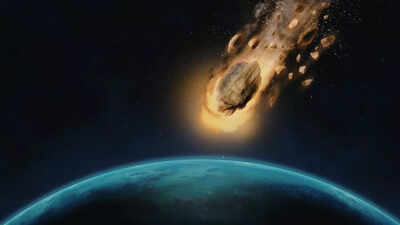
The Moon might be getting some attention in 2032. A small asteroid, roughly 60 metres wide, could smack it. Experts say the odds are low, about 4 percent, but that’s not zero. And that little number has scientists both nervous and excited. Nervous for obvious reasons: debris, satellite damage, potential fireballs raining down. Excited because it’s a rare chance to watch science happen live. A once-in-a-lifetime experiment. Imagine a medium-sized thermonuclear blast hitting the Moon and we just happen to be there to see it. The debris, the craters, the “moonquake” it seems almost unreal.
Asteroid 2024 YR4 could strike the Moon and fall on Earth

Asteroid 2024 YR4 is on a path that could intersect the Moon on December 22, 2032. If it does, the impact energy would be enormous; six orders of magnitude more powerful than the 2013 impact from a much smaller meteoroid. Scientists are already modelling what could happen. Craters roughly a kilometre wide, molten rock pools a hundred metres across. The Moon might shiver with a magnitude 5.0 moonquake. And the debris? Some 400 kilograms could survive reentry and hit Earth.People in the Pacific region might see the initial impact, lit up against the night skies. Infrared telescopes like the James Webb might track the cooling melt pool for days. Researchers will finally get real-time data on crater formation and lunar geology. It seems like a gift to physicists, but also a small, eerie reminder of how fragile things are up there.
Meteor showers and satellite risks from lunar debris
Simulations suggest millions of tiny meteors could enter our atmosphere per hour. Up to 400 fireballs might blaze across the sky every hour on the leading edge of the planet. South America, North Africa, and the Arabian Peninsula are in the line of fire. Most pieces would be small, but a few kilograms could hit cities. Dubai, for example, might see some damage. And the satellite constellations? They could be in real trouble. A cascade of debris might trigger Kessler Syndrome, wrecking our orbital networks for years.Space agencies are considering deflection missions. Push the asteroid aside, avoid the impact, save satellites. But if that happens, we’d miss the chance to witness a huge lunar impact and collect “free” lunar samples from debris. It seems like a strange trade-off: risk a few satellites for a once-in-a-lifetime spectacle.
The Moon could reveal its secrets after an asteroid hit
Watching the Moon quake and cool would reveal details about its interior. Patterns of molten rock spreading. Crater formation under extreme conditions. These are things simulations can only guess at. Observing it in real time might finally answer questions about the Moon’s composition, its seismic activity, and how it reacts to impacts of this scale.There’s a weird beauty in imagining it. A sky lit with fireballs. A glowing crater. Scientists scribbling notes, telescopes trained. People on Earth looking up and thinking about their tiny place in the cosmos. Even the risk feels like part of the thrill. Whether to try deflecting 2024 YR4 or letting nature take its course is a choice humanity will face. The odds are small, but not zero. And while we prepare, we can’t help but wonder what it would be like to see the Moon light up from a rock six times bigger than a city block hitting its surface.
Discover more from stock updates now
Subscribe to get the latest posts sent to your email.