




The Doomsday Clock shows the danger, but not a way-out for the world

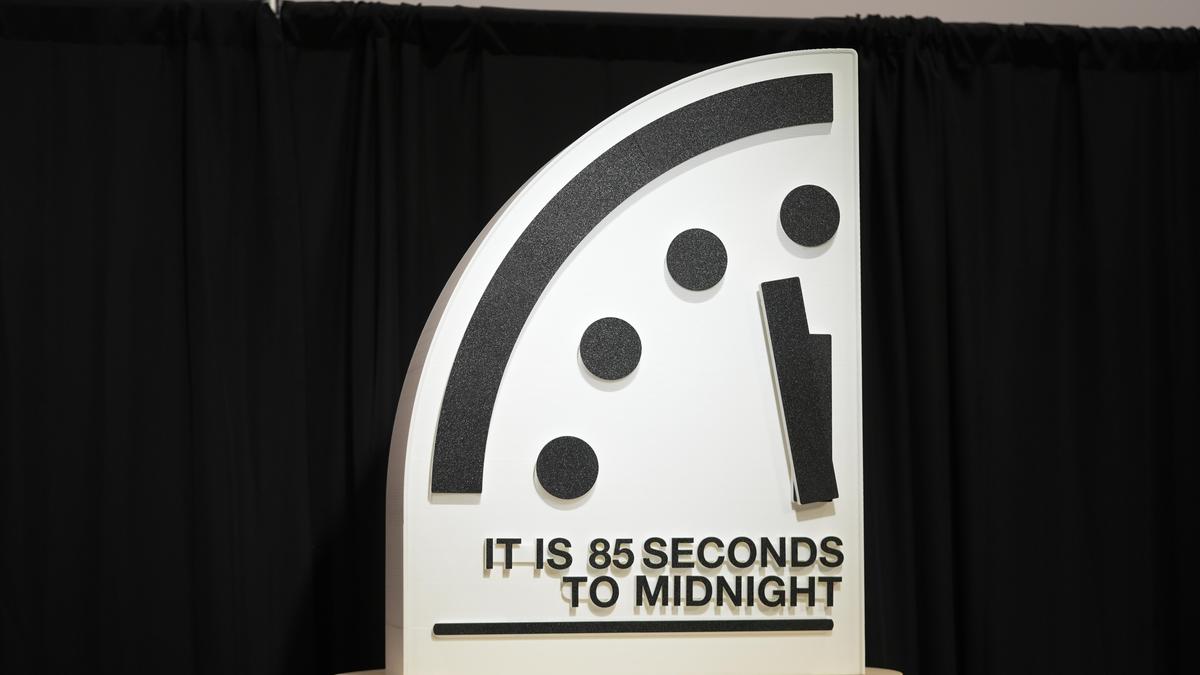
The Doomsday Clock, set at 85 seconds to midnight, is displayed during a news conference on January 23, in Washington
| Photo Credit: AP
As the Bulletin has moved the clock’s hands back and forth, but mostly forth, their movements have validated major arms control treaties or condemned dangerous escalations like the hydrogen bomb. And in the last eight decades it has become a cornerstone of the cultural framework that treats nuclear weapons and climate change as existential, rather than just political, problems.

But for all the ease with which the clock has raised alarms — thanks in no small part to its iconic design by the American artist Martyl Langsdorf — the clock has also failed to put out the fires. This is because the clock banks on the idea that if you show people a sufficiently frightening picture of their future, they will demand change. But history is clear that this strategy is flawed: while the clock has successfully branded the apocalypse, it has failed to overcome the political gridlock that actually drives the arms race.
That said, perhaps its most significant achievement is to set the agenda. Before the clock, nuclear strategy was a secret language spoken only by generals and physicists. The Bulletin changed that by creating a symbol everyone could understand, one of the number of minutes to midnight. This was clever because it forced the media to talk about nuclear risk every single year. It turned abstract scientific ideas into a story about time running out. When the U.S. and the Soviet Union signed major arms control treaties in the late 1980s and when the Copenhagen Summit concluded in 2009 with the 2º C climate goal, the clock moved backwards, giving people a clear way to see that diplomacy was working.
Unfortunately for the clock, constant fear often leads to paralysis, an effect psychologists call psychic numbing. When the clock stayed at two minutes to midnight for decades or hovered at 90 seconds as it did recently, its shock value wore off. Instead of rushing to fix the problem, people get used to living on the edge of destruction. Keeping the alert level so high for so long unintentionally normalised the very danger the Bulletin wished to eliminate. It’s understandable: if it’s always the end of the world, people stop believing the end is actually coming.
Equally understandably, the clock hasn’t been able to change the behaviour of national governments. The scientists behind the clock have appealed to securing the safety of the human race — what could be more important? — but governments have increasingly cared only about the safety of their own borders. And these goals often clash. For instance when India and Pakistan tested nuclear weapons in 1998, the Clock moved forward to condemn them, yet that condemnation meant nothing to the leaders in New Delhi or Islamabad, who believed they needed the weapons to survive. Even the current setting of 85 seconds to midnight is proof of this restriction: the fact that we’re closer to doom now than at any point in the Cold War suggests the people with the power to launch the missiles have ignored the clock’s warnings.
Too many threats
The clock’s effectiveness was further complicated when the Bulletin decided to include climate change and disruptive technologies in its calculations. To be sure, this decision was scientifically sound — climate change is indeed an existential threat — but it also muddled the message. Whenever the clock moved before, everyone knew it was about nuclear bombs. Today its moves are a mix of nuclear tension, rising temperatures, mis- and dis-information risks, biological threats, and so on. The clock is an example of science communication in action yet its attempts to account for all possible threats, even if they’re all equally real, undermines the people’s ability to understand what to demand from their leaders. A politician can claim they’re addressing the clock’s warning by passing a climate bill even as the government builds more nuclear weapons.
The Doomsday Clock is ultimately a good diagnostic tool, just not a cure. It banks on shame and reason in a world that, more signs by the day indicated, runs on fear and power. It tells us exactly what time it is but it’s silent on how we can stop the ticking.
Published – January 29, 2026 05:30 am IST
Discover more from stock updates now
Subscribe to get the latest posts sent to your email.
