


Can Venezuela produce 3 million barrels of crude oil a day?
Ronaldo Schemidt | Afp | Getty Images
Following the capture of Venezuela President Nicolás Maduro and his indictment in the U.S., attention has shifted to the potential for a U.S.-led effort to bring oil majors back to a politically unstable country which nationalized many of their assets in 2007, and revive crude output that has fallen significantly in recent decades.

Venezuela currently produces an average of 0.8 million barrels (800,000 barrels) of crude oil per day, well below its peak of 3.5 million barrels per day in the 1990s. Oil production declined sharply following the 2007 expropriation of U.S. oil major assets. Production fell further during the global oil crash of 2014-2016, when crude prices fell by as much as 70%. Even as oil prices stabilized in the latter half of that decade, Venezuelan production did not recover, and its production took a further hit from the pandemic-triggered oil price decline in 2020.
In the past few years, Venezuela’s oil production has recovered slightly, but more important to the global market is its oil reserves. According to research firm Wood Mackenzie, Venezuela has at least 241 billion barrels of recoverable crude oil. Analysts at Bernstein say that figure may be as high as 300 billion barrels of proven reserves, among the largest in the world. “Venezuela has the potential to be an oil superpower,” according to a recent note from Bernstein.
But Wall Street remains skeptical that those reserves can be turned into production upside any time soon.
Bernstein noted in its research that the sub-surface reserves are not the issue, and never have been. It is the “above-surface constraints” that pose the biggest issues for Venezuela. “Since the 2006/07 nationalization of western oil company interests by Hugo Chavez, lack of investment, mismanagement, neglect, have driven an oil production decline of 70% to just 1% of current global output,” it noted.
U.S. oil majors are also skeptical, for good reason. With oil trading around the $60 level, Western oil companies remain focused on capital discipline and efficient use of cash flow after being burned during the oil price crash of the last decade and punished by investors for overproduction and high exploration budgets. Add to that the specific risk of being “twice bitten by Venezuelan nationalization,” according to Bernstein, and it is a reason to remain “exceptionally cautious about committing fresh capital quickly.”
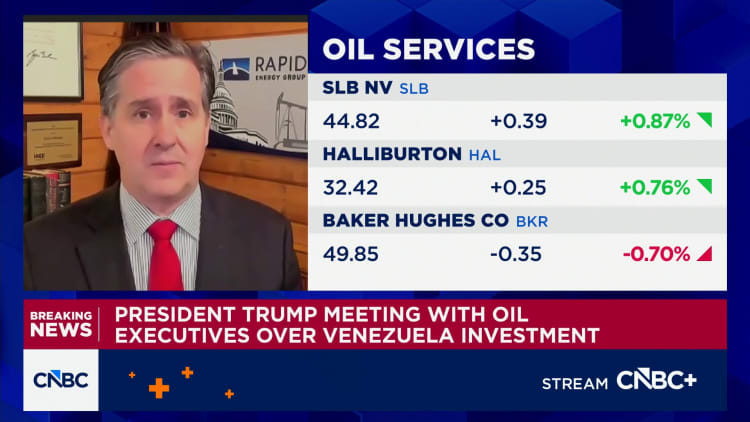
In fact, at the recent White House meeting with oil CEOs, after President Trump said U.S. oil companies would spend $100 billion on Venezuelan oil production, Exxon Mobil CEO Darren Woods voiced what was the underlying concern of many of his energy sector peers, telling Trump that the Venezuelan market is “uninvestable” in its current state.
Chevron, the only big U.S. oil company currently operating in Venezuela, holds a major advantage. The oil major has been operating in the country since 1923 and never left after the nationalization, with a joint venture with national oil company PDVSA currently at about 240,000 barrels per day. The company’s CEO Mike Wirth said at the White House meeting it could increase its production “within our own disciplined investment schemes by about 50% just in the next 18 to 24 months.”
U.S. Energy Secretary Chris Wright recently said the U.S. has received 30% higher prices for Venezuelan crude in its first sales since the military action. Trump has said Venezuela will turn over 30 million to 50 million barrels of sanctioned oil to the U.S., to be sold at market prices.
Wolfe Research believes production could increase to around 1 million bpd over the next few years with maintenance. “For now, we see the impact as less about oil prices than the potential for U.S. companies to recover legacy interests,” it wrote in a recent note.
However, the Trump administration has said new production rather than reclaiming nationalized assets is the top priority. Chinese and Russian state-controlled oil companies also hold the rights to millions of barrels in Venezuela, up to 6.5 million barrels, according to Wood Mackenzie and Morgan Stanley research.
The U.S. refining system, on the other hand, is particularly well placed to process Venezuela’s crude now. “In the absence of sanctions or other disruptions, U.S. Gulf Coast refiners are the natural destination of Venezuela’s crude,” Bernstein wrote. That bet has already paid off for some investors and refining stocks including Valero Energy. The first purchases of Venezuelan oil by U.S. refiners were made in recent days, including by Valero.
Recent Venezuelan oil production and exports fell to as low as 0.5 million bpd after the U.S. heightened pressure on the country under the weight of sanctions. BMO Capital Markets noted in a recent research report that it does not expect any meaningful near-term changes, but it does see potential over the longer term.
“We expect little change in oil export levels in the near term and concomitantly little impact on crude oil prices; however, if there is a larger change in control that allows a return of the U.S. majors (and potentially others) this could lead to higher production levels in 3-5 years,” BMO Capital Markets analysts wrote in their recent note.
JPMorgan Chase estimates that with political stability, unrestricted operations and new licensing deals, Venezuela could raise production quickly to as high as 1.2 million barrels per day within months, representing an increase of roughly 250,000 barrels per day compared to its 2025 average. Its team estimates that production could hit 1.4 million bpd in two years, and over the next decade, output could eventually reach 2.5 million bpd.
Goldman Sachs co-head of commodities research Daan Struyven said on a recent podcast that production could rise by about 50% by 2030, and potentially double if there is substantial investment from U.S. oil producers.
Other analysts note that rebuilding production will ultimately depend on large-scale investment. David Oxley, Capital Economics chief climate and commodities economist, said he estimates it would require around $15 billion to $20 billion in investment over the next decade in order to raise Venezuela’s oil output to 1.5 million bpd.
For now, Morgan Stanley sees the risks to production remaining “clearly to the upside” and cited similar scale of investment as a major factor. While an analysis from Wood Mackenzie that Morgan Stanley cites suggests that Venezuelan well workovers can boost production significantly, back to the range of two million barrels per day (the mid-2010s level) within a two-year period, it also predicts that the Venezuelan crude market will struggle beyond that level. “Going beyond that would require significant investments. Wood Mac estimates that it would take $15-20bn of investment over 10 year to add the next 0.5 mb/d,” Morgan Stanley wrote in a recent note to clients, and it added this outlook is contingent on government stability, sanctions policy and fiscal terms, “not just oil in the ground.”
“Getting oil production back up to 3+ million barrels in Venezuela would require a vast amount of investment – probably in the region of $180 billion over the next 15 years or so,” Oxley wrote in an email to CNBC.

Discover more from stock updates now
Subscribe to get the latest posts sent to your email.