Scientists move Doomsday Clock to 85 seconds before midnight: Are humans near extinction |
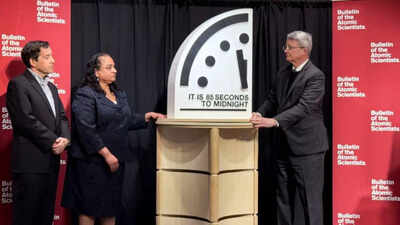
The Doomsday Clock now stands at 85 seconds before midnight. The change was announced by the Bulletin of the Atomic Scientists. Last year, it was set at 89 seconds. The clock is updated annually. It is meant to reflect global conditions, not predict specific events. Scientists involved in the process look at security risks, environmental trends, and emerging technologies.This year’s decision followed discussions around nuclear policy, climate pressures, and the pace of technological change. The Bulletin said these factors were considered together rather than in isolation.The clock has never been set this close to midnight before.
Doomsday Clock warns of rising nuclear dangers and treaty challenges

Alexandra Bell, president of the Bulletin of the Atomic Scientists, said recent developments offered little reassurance on nuclear risk. Several arms control agreements remain under strain, while others face expiration. According to Reuters, she referred to Russia’s war in Ukraine, military activity involving the US and Israel in Iran, and ongoing tensions between India and Pakistan. Issues in East Asia, including the Korean Peninsula and Taiwan, were also cited.Bell said competition among major powers has complicated cooperation. Analysts have made similar observations in recent years, pointing to reduced diplomatic engagement and limited progress on arms control. The New START treaty, which caps deployed nuclear warheads, expires in February. Russian President Vladimir Putin has reportedly suggested a one-year extension. The US has not publicly responded. In October, Trump ordered a review of nuclear testing procedures, a move that drew attention from policy experts.
AI and climate change adding to global danger
Nuclear weapons are not the only factors considered in the clock’s setting. Artificial intelligence and climate trends were also part of the discussion.Some experts have expressed concern about how rapidly AI systems are being adopted, particularly in areas linked to security and information sharing. Nobel Peace Prize winner Maria Ressa has spoken about the effects of technology on public discourse and trust. Climate change remains a separate but ongoing issue. Scientists continue to track rising temperatures and weather extremes. These developments are widely documented in long-term climate data.
Global leadership crisis
Bell said the clock also reflects broader challenges in international coordination. Political tensions and strategic rivalries have made collective action more difficult, according to the Bulletin. These dynamics are visible across regions, including Europe, Asia, and the Americas. Experts say the issue is not a single crisis, but the accumulation of unresolved ones.
What the Doomsday Clock has been trying to tell us
In 1947, the Doomsday Clock was created to illustrate nuclear risk during the early Cold War. Over time, it has been adjusted forward and backwards as conditions changed. Last year’s setting was already close to midnight. This year’s shift was smaller, but scientists said it reflected continuity rather than sudden change. The Bulletin has stressed that the clock is symbolic. It is intended to prompt discussion, not alarm. Researchers involved say progress remains possible through diplomacy, regulation, and international cooperation.The clock, they say, is a signal, not a countdown!
Discover more from stock updates now
Subscribe to get the latest posts sent to your email.