Nobel Laureate Roy Glauber says science is guesswork, not perfect logic: What students and teachers often miss
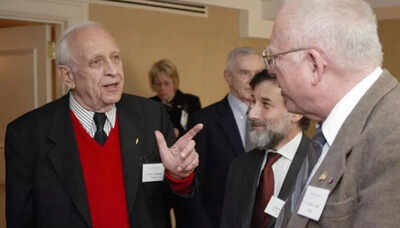
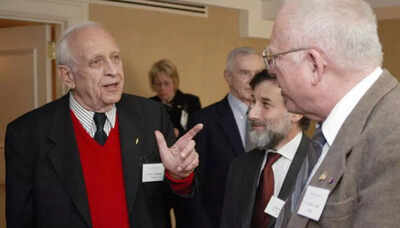
Scroll past enough career advice on social media and you’ll start to believe that success is a straight line: study hard, follow the method, master the rules, and the results will come. There’s a quiet but damaging myth many of us pick up early in school: that science is neat, linear, and deductive. You start with axioms, follow the steps, and—if you’re smart enough—the answer appears. It’s a comforting story. It’s also wrong.In a recent post shared by The Nobel Prize on X, 2005 physics Nobel laureate Roy Glauber reflected on this misconception: “Too many kids in school get the notion that science is deductive, and deductive science is almost never creative. Real ideas arrive via intuition, via guesswork, and we’re guessing all the time.”Coming from anyone else, that might sound like motivational fluff. Coming from a Nobel Prize–winning physicist—the man often called the Father of Quantum Optics—it lands very differently. That single quote should probably be taped to the wall of every classroom, lab, and early-career researcher’s office.A career shaped by curiosity and intuitionGlauber’s own career is a case study in how non-linear real scientific lives actually are. He didn’t emerge fully formed as the so-called “Father of Quantum Optics.” He grew into the role by following curiosity, responding to opportunity, and—yes—by guessing.As a teenager, Glauber found himself working at Los Alamos during the Manhattan Project, surrounded by some of the most brilliant minds of the 20th century. It was an unusual and intense environment, one that shaped his instincts as a theorist. Later, Princeton became his intellectual home, at a time when it was a post-war hotspot for theoretical physics. None of this followed a tidy roadmap. It followed momentum.The courage to notice what others ignoreWhat’s striking in Glauber’s interviews, posted on nobelprize.org, is how little he romanticizes certainty. When he talks about the early days of quantum optics, he describes a field that almost didn’t exist yet. Light had long been understood as having a “granular structure,” but most physicists were content to rely on older theories that explained average intensity, not the deeper statistical behavior of light.People, he admitted, were “rather lazy about it.”Glauber wasn’t. In the early 1960s, he sensed that new developments demanded “a much more vigorous version of the quantum theory,” even if that meant embracing the “frightening name” of quantum electrodynamics. That instinct—to take a problem seriously before it’s fashionable—became the foundation of his Nobel-winning work.Career advice often gets reduced to slogans: specialize early, follow the rules, optimize your résumé. Glauber’s life points in the opposite direction. His breakthroughs didn’t come from rigid deduction but from intuition sharpened over time. From noticing what others were willing to ignore. From staying playful with ideas long after most people would have settled.Lessons for the next generationEven his reaction to winning the Nobel Prize underscores this humility. When the phone rang at 5:36 a.m., he said he could “scarcely believe it.” The experience, he joked, felt like being “swept up into the vortex of a bit of a tornado.” Not triumph. Disorientation.And yet, the morning after becoming a Nobel laureate, Glauber did something deeply unfashionable: he went back to teaching. He spoke fondly of seminars with nine students, admitted to lecturing when he wasn’t supposed to, and talked about wearing out his voice in class. “I have very little taste for retirement,” he said.For Glauber, science was never a ladder to climb; it was a practice to stay engaged in. Mentoring mattered. Curiosity mattered. The work itself mattered more than the recognition.In an era obsessed with outcomes—grants, titles, citations—Glauber’s reminder feels almost radical. Creativity doesn’t come from perfect logic. Careers don’t unfold according to clean syllabi. Progress depends on people willing to guess, to be wrong, to follow intuition into unfamiliar territory.If we want more creative scientists—or creative professionals of any kind—we might start by telling kids a different story. One where guessing isn’t a failure. It’s the job.

Discover more from stock updates now
Subscribe to get the latest posts sent to your email.