


Scientists believe they’ve found the best place on Mars for future human landings |
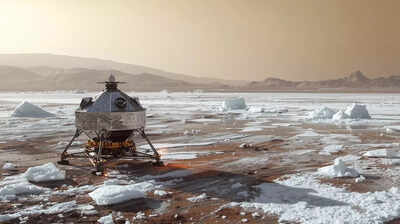
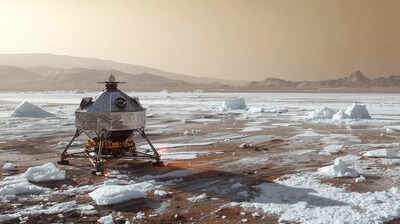
Arcadia Planitia does not receive the same level of attention as Mars’s big canyons and volcanoes. It rests calmly over the northern mid latitudes, flat and vast, frequently overlooked in favour of more striking scenery. However, in recent years, this region of the earth has resurfaced as a focus of scientific inquiry. A rising collection of orbital data indicates that ice exists just beneath the surface, close enough to matter. Researchers examining the boundary between Arcadia Planitia and northern Amazonis Planitia have concentrated on minor surface patterns rather than prominent features. What they see suggests that buried ice has survived temperature variations on Mars. The work does not answer all questions, but it does reduce the field. For planners considering human missions, the region appears less distant and more practical than before.
Future human landings may hinge on a quiet stretch of Mars
Across several candidate landing sites, researchers mapped features that are difficult to explain without ice below the surface. Polygonal ground appears in wide patches, its cracked geometry resembling periglacial terrain on Earth. Some polygons are knobbly, others smoother, but both suggest repeated freezing and thawing long ago. Expanded craters, with softened rims and altered shapes, also point to subsurface ice that changed the way impacts behaved. None of these features proves ice on its own. Together, they begin to lean in the same direction.

Ice appears closer to the surface than expected
By measuring the size and spacing of thermal contraction polygons, scientists estimated how deep the ice might be. In many places, it seems to lie just tens of centimetres below the surface. That depth matters. Ice that shallow would be far easier to reach than deposits locked metres down. Recent impact craters nearby have exposed bright material that fades over time, a behaviour consistent with ice sublimating away. Not every crater shows this, which suggests the ice is unevenly distributed rather than continuous.
Climate cycles left traces that remain today
Mars’s tilt varies. Over millions of years, obliquity variations influenced where ice could exist. During periods of higher tilt, water vapour in the atmosphere rose, and ice stabilised at lower latitudes. Snow and ice undoubtedly accumulated in areas such as Arcadia Planitia. When conditions changed again, the ice was buried in dust and debris, forming a protective layer. Models imply that this coating formed swiftly in order to preserve the ice during warmer periods. If such models are correct, what remains today is a record of previous climates stored just beneath the surface.
Different instruments tell overlapping stories
According to a study titled “Geomorphological Evidence of Near-Surface Ice at Candidate Landing Sites in Northern Amazonis Planitia, Mars”, radar data, neutron measurements, and thermal observations do not always agree in detail, but they often overlap in broad conclusions. Radar soundings hint at ice-rich material beneath Arcadia Planitia, though there is debate over whether it is solid excess ice or ice filling pores in the soil. Neutron detectors have measured elevated hydrogen levels, consistent with frozen water, at depths of about a metre. Thermal data shows surface behaviour that fits with ice-cemented ground. Each dataset has limits. None offers a clean answer on its own.
Planning for humans brings new urgency
Beyond science, the presence of near-surface ice changes how Mars is discussed. Ice is not only a record of climate. It is water for drinking, oxygen, and fuel. Regions where it can be accessed without heavy drilling become more attractive as landing sites. Teams have produced detailed geomorphic maps of specific areas in northern Amazonis Planitia to support this planning. International cooperation has grown around this work, reflecting shared interest rather than certainty. The maps do not promise ease. They suggest a possibility.The picture that emerges is incomplete and slightly uneven, much like the terrain itself. Arcadia Planitia does not offer a clear line from orbit to settlement. It offers hints. Shallow ice here. A crater there. Patterns that repeat but not everywhere. For now, that may be enough to keep the region in focus as Mars moves from a distant target to a place considered more closely than before.
Discover more from stock updates now
Subscribe to get the latest posts sent to your email.