Wall Street rebounds after Trump says ‘I won’t use force’ on Greenland – National

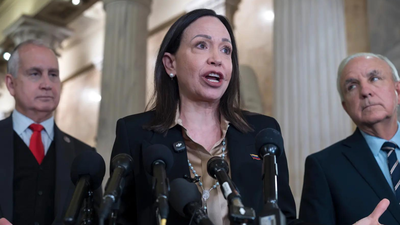
The S&P 500 climbed 0.7 per cent after Trump said in a speech before business and government leaders in Europe that he would not use force to take “the piece of ice.” The potential de-escalation in rhetoric around Greenland helped the index recover some of its 2.1 per cent drop from the day before and pull closer to its all-time high set earlier this month.

“We probably won’t get anything unless I decide to use excessive strength and force where we would be, frankly, unstoppable. But I won’t do that,” said Trump in his speech on Wednesday.
“I don’t have to use force. I don’t want to use force. I won’t use force.“
The Dow Jones Industrial Average was up 353 points, or 0.7 per cent, as of 10:15 a.m. EST, and the Nasdaq composite was 0.7 per cent higher.
Treasury yields also held steadier in the bond market, a day after jumping in a potential signal of worries about higher inflation in the long term. They got help from a calming of government bond yields in Japan. The value of the U.S. dollar was also mixed against the euro, Swiss franc and other currencies after sliding the day before.
But some nerves seemed to remain in the market, and the price of gold rose another 2.1 per cent and topped USD$4,800 per ounce for the first time.

Get weekly money news
Get expert insights, Q&A on markets, housing, inflation, and personal finance information delivered to you every Saturday.
Trump himself acknowledged how his desire for Greenland led to Tuesday’s drop in the stock market, but he called it “peanuts compared to what it’s gone up” in the first year of his second term and said it would go up more in the future. While saying he would not use force to take Greenland, he also called for “immediate negotiations” for the United States to acquire it from Denmark.
Helping to lead the U.S. stock market was Halliburton, which rose 3.9 per cent after the oilfield services company reported a stronger profit for the latest quarter than analysts expected.

United Airlines climbed 4.2 per cent after likewise reporting a better profit for the end of 2025 than expected. CEO Scott Kirby said that the airline’s strong momentum in revenue is continuing into 2026.
They helped offset a 2.6 per cent drop for Netflix. The streamer sank even though it reported a stronger profit than expected as investors focused instead on a drop in its subscriber growth.


Kraft Heinz sank 4.9 per cent after Berkshire Hathaway warned investors Tuesday that it may be interested in selling its 325 million shares in the name brand food giant that former CEO Warren Buffett helped create back in 2015.
Berkshire took a $3.76 billion write-down on its Kraft-Heinz stake last summer. Buffett said last fall that he was disappointed in Kraft Heinz’ plan to split the company in two, and Berkshire’s two representatives resigned from the Kraft board last spring.
In the bond market, the yield on the 10-year Treasury eased to 4.28 per cent from 4.30 per cent late Tuesday. But it’s still well above the 4.24 per cent level where it was at on Friday, before Trump said he will impose 10 per cent tariffs on Denmark, Norway, Sweden, Germany, France, the United Kingdom, the Netherlands and Finland beginning in February.
That would be on top of a 15 per cent tariff specified by a trade agreement with the European Union that has yet to be ratified.
Natural gas futures rose more than eight per cent in anticipation of demand for more heating as a cold snap and brutal storms hit large swaths of the United States.
In stock markets abroad, indexes were mixed in mostly modest movements across Canada, Europe and Asia.
The Toronto Stock Exchange was up about 0.4 per cent.
Japan’s Nikkei 225 slipped 0.4 per cent.
The country’s prime minister, Sanae Takaichi, has called a snap election for Feb. 8, which sent yields of long-term government bonds to record levels. The expectation is that Takaichi, who is capitalizing on strong public support ratings, will cut taxes and boost spending, adding to the challenges Japan faces in handling its massive government debt.
The yield on the 40-year Japanese government bond pulled back to 4.05 per cent Wednesday, down from 4.22 per cent level that it surged to on Tuesday.
– With a file from Global’s Ariel Rabinovitch
© 2026 The Canadian Press
Discover more from stock updates now
Subscribe to get the latest posts sent to your email.