Trump bid to fire Fed Governor Lisa Cook set for arguments
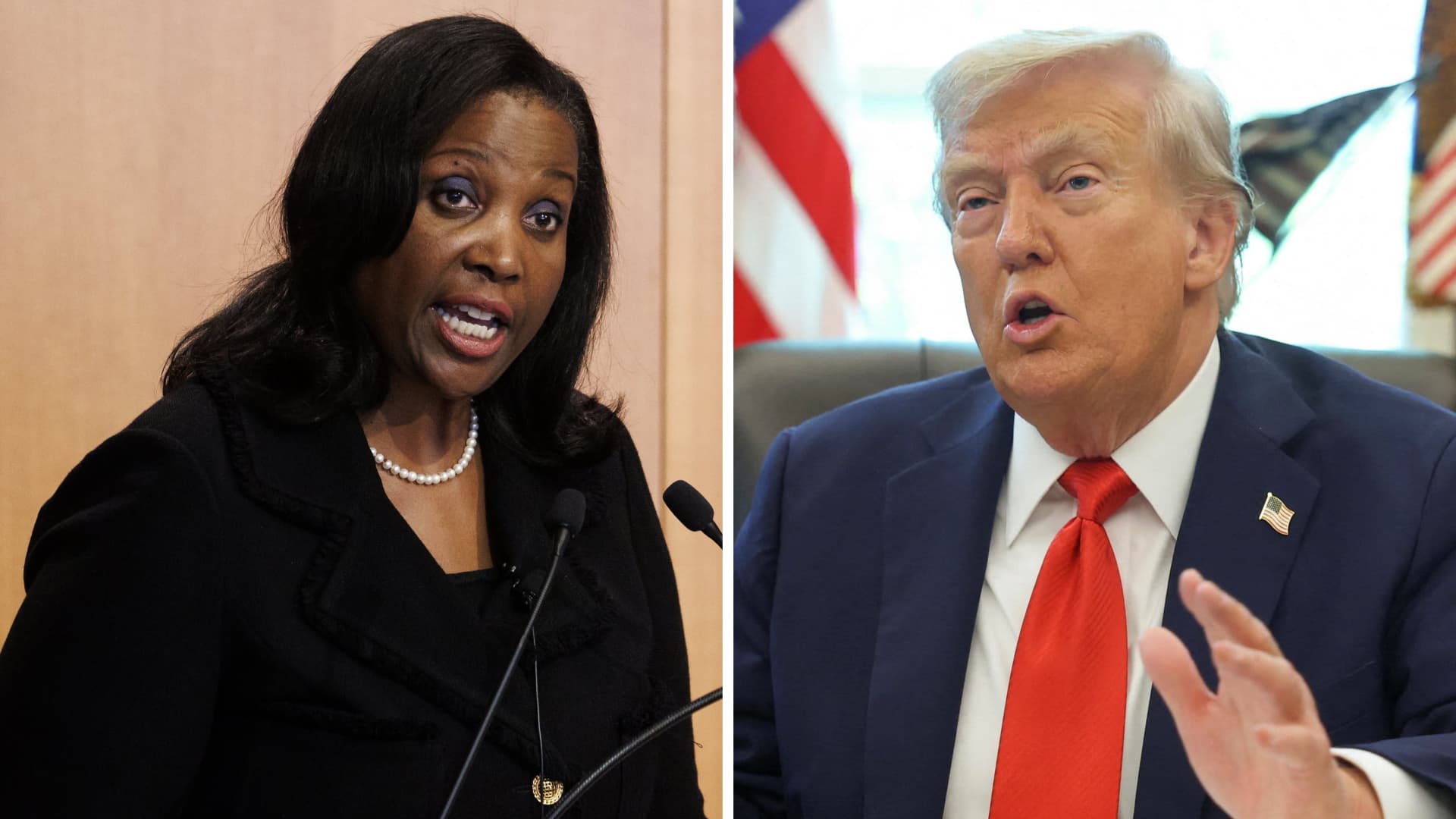
Ting Shen | Bloomberg | Getty Images | Jonathan Ernst | Reuters
At stake is not only the fate of Cook — who denies any wrongdoing — but potentially the Fed’s future independence to set monetary policy without the risk of a president being able to easily remove a governor who fails to do their bidding on that issue.
Underscoring those stakes is the recent disclosure by Fed Chairman Jerome Powell that he is the subject of a criminal investigation by the U.S. Attorney’s Office in Washington, D.C., in connection with his oversight of a multi-billion-dollar renovation of the central bank’s headquarters there.
Powell, who plans to attend Wednesday’s arguments at the Supreme Court, has said the real reason for that probe is the Fed holding interest rates steady for much of last year to Trump’s ire.

Cook was one of the Fed governors who backed Powell in maintaining those rates.
When Trump moved to fire Cook in late August — the first time a president had ever attempted such a move — there was immediate speculation it was due to her refusal to agree to cut interest rates as Trump wanted.
If Cook and Powell were to be removed from the Fed’s seven-member board, Trump would be in a position to appoint a majority of that board — and, theoretically at the least, have more influence over interest rate decisions.
Trump did not cite Cook’s stance on interest rates when he said he was firing her.
Instead, the president cited allegations made by Federal Housing Finance Director Bill Pulte that she had made false statements in applying for home mortgages, which predated her appointment to the Fed by then-President Joe Biden in 2022 to fill an unexpired board term.
Cook, the first Black woman to serve on the Fed board, was reappointed by Biden in 2023 to serve a full 14-year term.
Under the Federal Reserve Act of 1913, only the president can terminate a Fed board member, and a governor like Cook can only be terminated “for cause.”
The law does not detail what would constitute “cause,” but cause has historically been understood to mean malfeasance or dereliction of duty.
After Cook sued Trump to block her removal from the Fed, a federal District Court judge in Washington ruled that she could remain with the central bank pending the outcome of her lawsuit.
Judge Jia Cobb, in that ruling, wrote that “Cook has made a strong showing that her purported removal was done in violation of the Federal Reserve Act’s ‘for cause’ provision.”
Cobb said that “best reading” of that provision is that the alleged cause for removal relates to a governor’s actions while “in office.”
The allegations against Cook relate to actions she took before joining the Fed.
The Department of Justice appealed Cobb’s ruling, but was unsuccessful. The DOJ then asked the Supreme Court to take the case.
In a filing, the DOJ said that the “determination of cause” for termination is subject to “the unreviewable discretion of the President.”
“In any case, the President has identified sufficient cause here,” the filing says.
“That the Federal Reserve Board plays a uniquely important role in the American economy only heightens the government’s and the public’s interest in ensuring that an ethically compromised member does not continue wielding its vast powers,” the filing says
“Put simply, the President may reasonably determine that interest rates paid by the American people should not be set by a Governor who appears to have lied about facts material to the interest rates she secured for herself—and refuses to explain the apparent misrepresentation,” the filing said.
A general view of U.S. Supreme Court as justices could issue at least one ruling in several major cases pending including a decision on the legality of President Donald Trump’s sweeping global tariffs, in Washington, D.C., U.S., Jan. 20, 2026.
Nathan Howard | Reuters
All three former living Fed chairs — Alan Greenspan, Ben Bernanke, and Janet Yellen — signed on to a legal brief with the Supreme Court arguing against Cook’s removal, along with a group of former Treasury secretaries, chairs of the White House Council of Economic Advisers, and others.
The brief says that Congress “intentionally” designed the Fed “as a uniquely independent entity, largely insulated from political pressures that could otherwise prioritize short-term economic gain over long-term stability and growth.”
“Granting the government’s request to remove Governor Cook from the Board immediately would upset these longstanding protections and the essential functions they serve,” the brief says. “Doing so would expose the Federal Reserve to political influences, thereby eroding public confidence in the Fed’s independence and jeopardizing the credibility and efficacy of U.S. monetary policy.”
Discover more from stock updates now
Subscribe to get the latest posts sent to your email.