



New state of matter is a solid-liquid hybrid

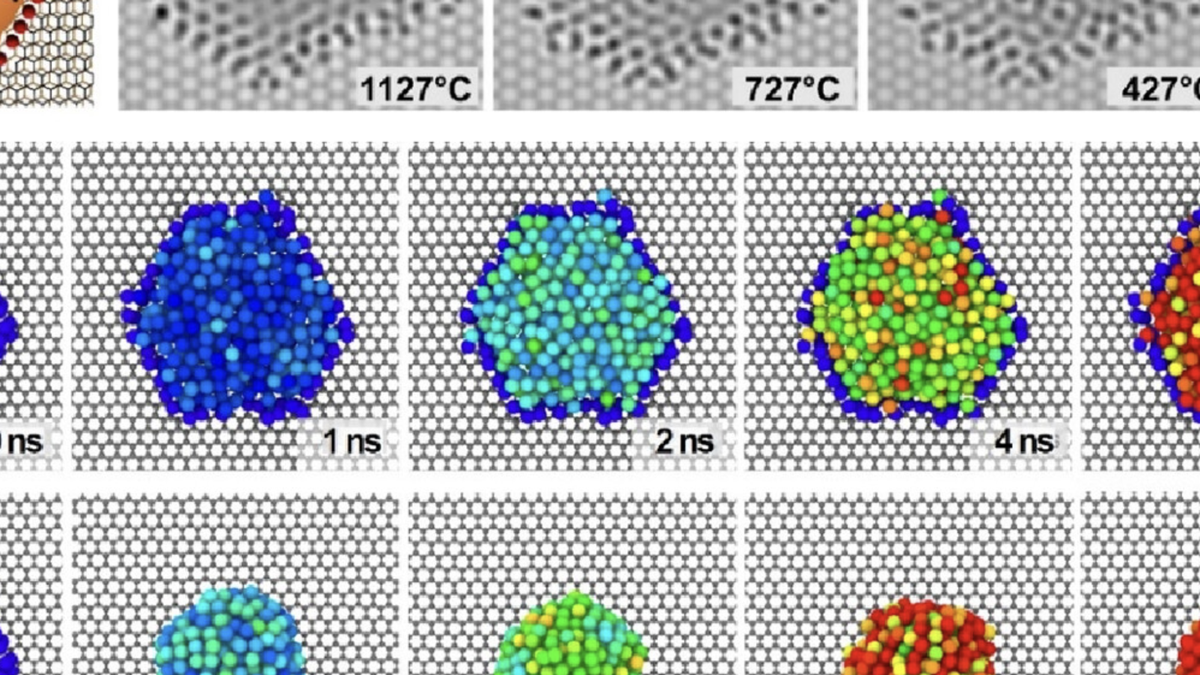
An image from the paper showing the corralling effect in action.
| Photo Credit: ACS Nano, 2025, 19 (50), 42002-42012
The newfound material isn’t a slush or a gel in the macroscopic sense but refers to a specific atomic structure where different parts of a single nanoparticle exist in different states at the same time.
As a result, the nanoparticle displays the properties of solids and liquids both, but also unique behaviours that neither a pure liquid nor a pure solid would display on its own.

Conventionally, physicists assume the atoms in a solid are stationary while those in a liquid are moving fast and in random ways. The researchers sought to investigate the boundary between these phases at the nanoscale, specifically looking at how the presence of stationary atoms within a liquid nanoparticle influences the solidification process.
The team used a technique called high-resolution transmission electron (HRTE) microscopy to observe nanoparticles of platinum, palladium, and gold deposited on graphene, and complemented what they observed with mathematical calculations.
This way the team found that even when nanoparticles are in a liquid state, they contain individual metal atoms that remain stationary because they’re confined to gaps in the graphene’s network of carbon atoms.
When a large number of stationary atoms aligned along the perimeter of a nanodroplet, they would effectively corral the liquid core.
Under the HRTE microscope, the stationary atoms appeared as distinct and clearly demarcating features while the liquid core appeared transparent or blurry, since the atoms here were moving faster than the image capture time.
As a result the nanodroplet could remain liquid at temperatures of 200-300º C, significantly lower than unconfined particles that crystallised only at around 500º C. The physical constraints also caused the supercooled liquid to not form a standard crystal lattice when it cooled. Instead it formed a disordered solid.
The findings suggest that the boundary between solid and liquid phases at the nanoscale isn’t as distinct as scientists have thought it to be.
The most significant novel property the nanoparticle exhibited was the ability to remain liquid at temperatures far below the normal freezing point. And when it did freeze, it formed a disordered solid that was chemically identical to the metal but structurally distinct from its natural crystal form.
This is particularly relevant for scientists designing heterogeneous catalysts such as platinum on carbon. In fact platinum on carbon is the primary catalyst in proton exchange membrane fuel cells and direct methanol fuel cells, which are used to power hydrogen electric vehicles and stationary power generators. These catalysts are also used to speed up hydrogenation reactions essential to produce pharmaceuticals and petrochemicals and to break down organic pollutants in vehicle emissions.
In all these applications, platinum particles normally clump together or get poisoned over time and lose their effectiveness.
In a future catalyst, the researchers expect the corralling could pin the nanoparticles to prevent clumping while maintaining the active liquid or amorphous states, allowing catalysts to continue being effective rather than become unavailable.
Published – January 19, 2026 12:11 pm IST
Discover more from stock updates now
Subscribe to get the latest posts sent to your email.