A ban, a split verdict, and a health concern

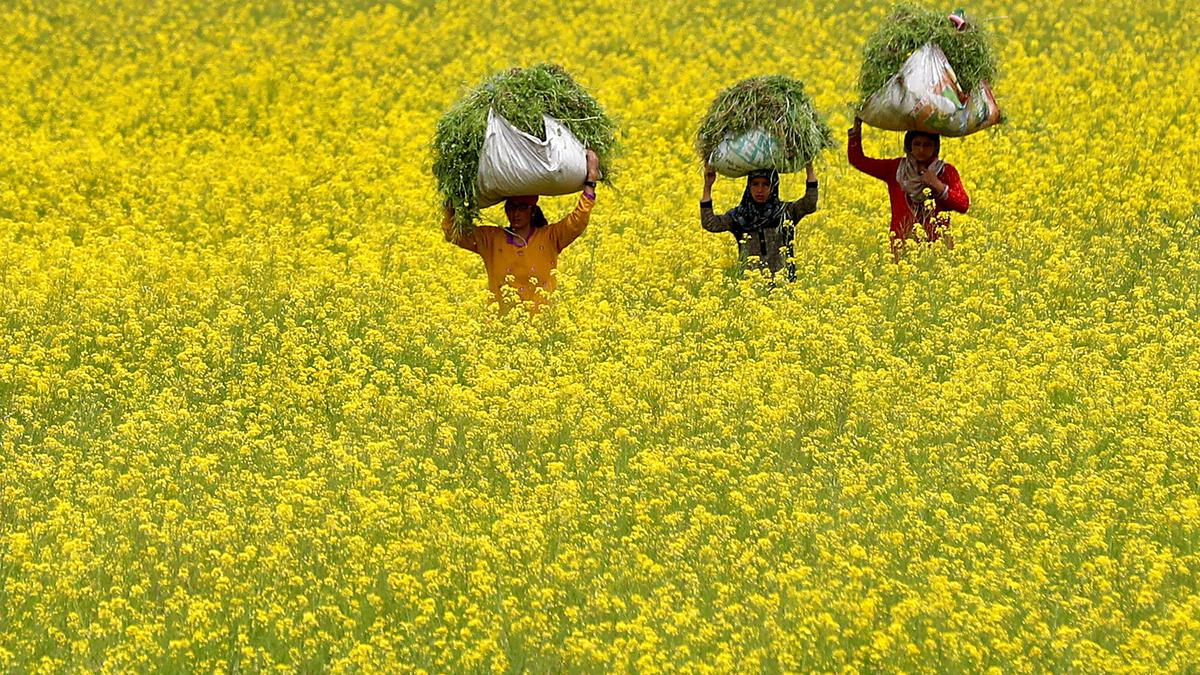
Women carry fodder for their cattle through a mustard field on the outskirts of Srinagar. File
| Photo Credit: Reuters
Erucic acid
The mustard oil extracted from the Indian mustard crop contains high levels of a unique fatty acid called erucic acid (40% to 54% of total fatty acid). This is significantly higher than the internationally accepted level of <5%. Mustard oil containing high erucic acid is considered undesirable for human consumption, particularly in advanced countries such as the U.S., Canada, and Europe. Lab experiments demonstrated that animals fed with high erucic acid-containing mustard oil suffered from heart diseases, retarded growth, premature tissue death, and adverse changes to the liver, kidney, skeletal muscle, and adrenal glands. Though there is no conclusive evidence of a similar health impacts on humans, the stigma of the high erucic acid in mustard oil prevails in advanced economies. In those countries, the erucic acid content of mustard oil is strictly controlled by using canola oil for culinary purposes. Canola crop (oil), developed by Canada, contains less than 2% erucic acid content.

Edible oil blending
Due to unfavourable climatic conditions, India has not succeeded in developing a high-yielding canola-quality mustard crop. Hence, the easiest way to reduce the high erucic acid content in mustard oil is to blend it with other edible oils. Several scientific studies have proved the lower presence of erucic acid in blended mustard oil. Also, since blended mustard oil is rich in unsaturated fatty acid, consuming it lowers LDL cholesterol and increases HDL cholesterol. One primary concern with edible oil blending is adulteration with artificial flavours and poisonous substances. A nationwide survey by FSSAI in August 2020 found that 24.21% of the 4,461 edible oil samples collected did not meet the quality parameters criteria. A maximum number of adulteration and contamination was found in mustard oil.
Instead of a ban, the sale of blended mustard oil can be allowed but in packaged/branded form with an explicit declaration regarding the oils that have been blended. The share of branded edible oil consumed in India is less than 30%. Strict implementation of the food safety and standards laws and strengthening of food safety infrastructure are also essential in preventing adulteration. Since health is a State subject, the food safety administration at the State level has to play a vital role in this regard. As per industry sources, the proportion of other oils blended with mustard oil in India ranges from 5% to 50%. Though this does not conform with the law, which allows blending up to 20%, it has the unintended positive consequence of reducing the erucic acid content. Hence, the sale of blended mustard oil should not be banned entirely.
GM mustard
Alternatively, the erucic acid content in Indian mustard oil can be reduced by cultivating the indigenous GM mustard crop DMH-11, which, apart from higher yield, has a lower erucic acid content (30-35%) compared to the traditional Indian mustard crops (40-54%). As a result, the oil extracted from DMH–11 requires a lower quantity of other edible oils for blending to reduce erucic acid content. This, in turn, helps to reduce the imports of other edible oils. India is the world’s largest importer of edible oils. Its edible oil import bill is pegged at $20.56 billion by NITI Aayog.
Therefore, the erucic acid-reducing property of DMH–11 and the associated health and economic benefits (in terms of reduced edible oil imports) need to be factored in by all the stakeholders while deciding on the approval of the GM mustard crop. The development of the indigenous DMH-11 with a lower erucic acid content is by no means a notable achievement by Indian genetic scientists. After years of research, Canada and Europe have successfully introduced low-erucic acid traits into their rapeseed cultivars. Hence, plant breeding programmes aimed at reducing the erucic acid content in the mustard crop to an internationally accepted level of <5% should be given top priority in India’s indigenous GM mustard crop development programmes.
Sthanu R Nair, Professor of Economics, Indian Institute of Management Kozhikode. Views are personal
Published – June 04, 2025 01:49 am IST
Discover more from stock updates now
Subscribe to get the latest posts sent to your email.