Why DeepSeek didn’t cause an investor frenzy again in 2025
Stocks of some of the leading Western tech companies plunged as the markets hit panic mode at the prospect of a new model from a relatively unheard of Chinese AI lab that challenged the premise of U.S. dominance in the space.
Nvidia plummeted 17%, losing close to $600 billion from its market cap. U.S. chipmaker Broadcom also fell 17%, and ASML dropped 7% in a single day.
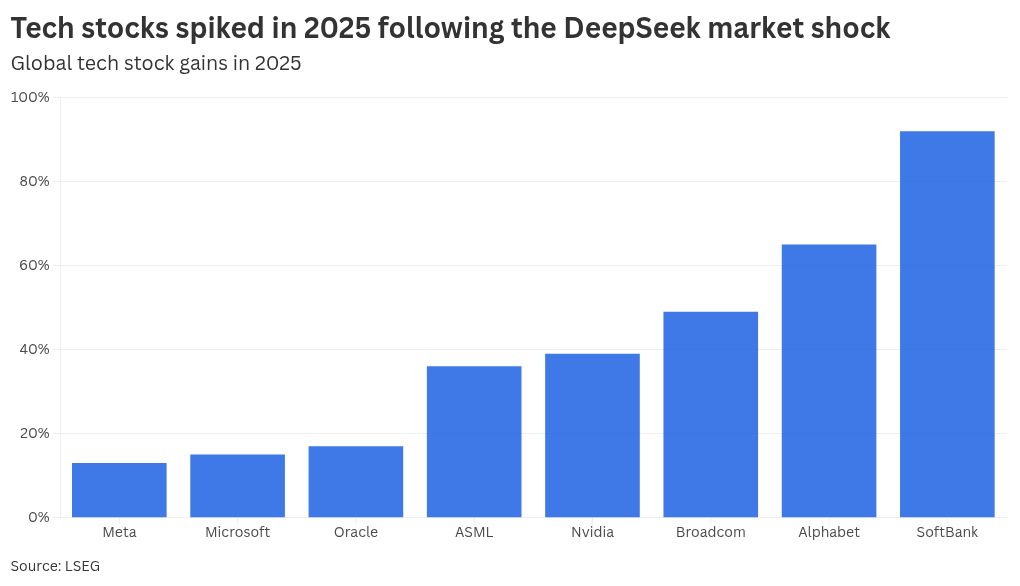
Eleven months on, and those companies have not just recovered but continued to grow. Nvidia became the first company to hit a $5 trillion valuation in October, Broadcom’s shares rose 49% across 2025, with ASML’s stock increasing 36%.

Since then, DeepSeek has released seven new model updates. None have caused the kind of waves seen in January. So why haven’t the markets reacted?
Shock factor
Founded in 2023, DeepSeek released a free, open-source large language model (LLM) in late 2024, called V3, which it said was trained with less powerful chips and at a fraction of the cost of models built by the likes of OpenAI and Google.
Weeks later, in January 2025 it released a reasoning model, R1, that hit similar benchmarks or outperformed many of the world’s leading LLMs.
The Chinese AI lab’s January release “really surprised the market,” Alex Platt, senior analyst at investment firm D.A. Davidson, told CNBC. “The narrative [at the time] was that China was 9 to 12 months behind the U.S.”

The promise of a model achieving similar results to the most advanced systems, but using less compute, raised concerns in the market that the demand for AI infrastructure would be impacted, and revenue for firms like Nvidia would be hit, Brian Colello, senior equity analyst at Morningstar, told CNBC.
“Instead, we saw no slowdown in spending in 2025, and as we look ahead, we foresee an acceleration of spending in 2026 and beyond.”
There’s also the type of releases DeepSeek has made since January, all of which have been updates to the V3 and R1 models as opposed to entirely new models.
While DeepSeek’s more recent model updates are “credible step changes” in efficiency and capability, the market has viewed them as a “continuation and consolidation rather than a new shockwave,” Khandabattu said.
Limited compute
Part of the reason DeepSeek hasn’t released a new model is likely due to limited compute, analysts told CNBC.
“Compute has been a large bottleneck,” said Platt. “You can only do so much algorithmic research and find so many architectural ingenuities.”
The AI company delayed the release of its R2 model, which was initially planned for May, because of challenges training it on homegrown Huawei chips, the Financial Times reported in August.
Chinese authorities had encouraged DeepSeek to use the processors as it looked to reduce reliance on U.S. alternatives in the face of export controls on Nvidia’s most powerful chips, the publication said. DeepSeek has been approached for comment on the report.
“China’s been constrained in the amount of computing power it’s been able to access over the last couple of years, in large part because of U.S. restrictions on the sale of chips,” Chris Miller, author of “Chip War,” told CNBC.
“If you want to build advanced models, you need access to advanced compute.”
DeepSeek said in a research paper it released earlier this month that it acknowledges “certain limitations when compared to frontier closed-source models” such as Gemini 3, including compute resources.

Markets have also been reassured of continued U.S. leadership in the AI space by new advanced model releases from frontier labs in the West.
In August, OpenAI unveiled GPT-5, Anthropic released Claude Opus 4.5, and Google launched Gemini 3 in November.
“The competition between these providers is intense with rapid model releases and incremental improvement in capabilities,” Gartner Analyst Arun Chandrasekaran told CNBC. “As a result, fears of a sudden commoditization shock have eased.”
But there are signs DeepSeek is gearing up for a more significant model release in the coming months. On New Year’s eve the company published a paper detailing a more efficient way of developing AI models.
Wedbush Securities’ Dan Ives thinks there are more shocks in the market to come. “Some of these moments that we’ve seen, we’ll continue to see next year,” he told CNBC.
“There’ll be another DeepSeek.”
Discover more from stock updates now
Subscribe to get the latest posts sent to your email.