4 Takeaways From Purdue’s Thrilling OT Win Over Nebraska
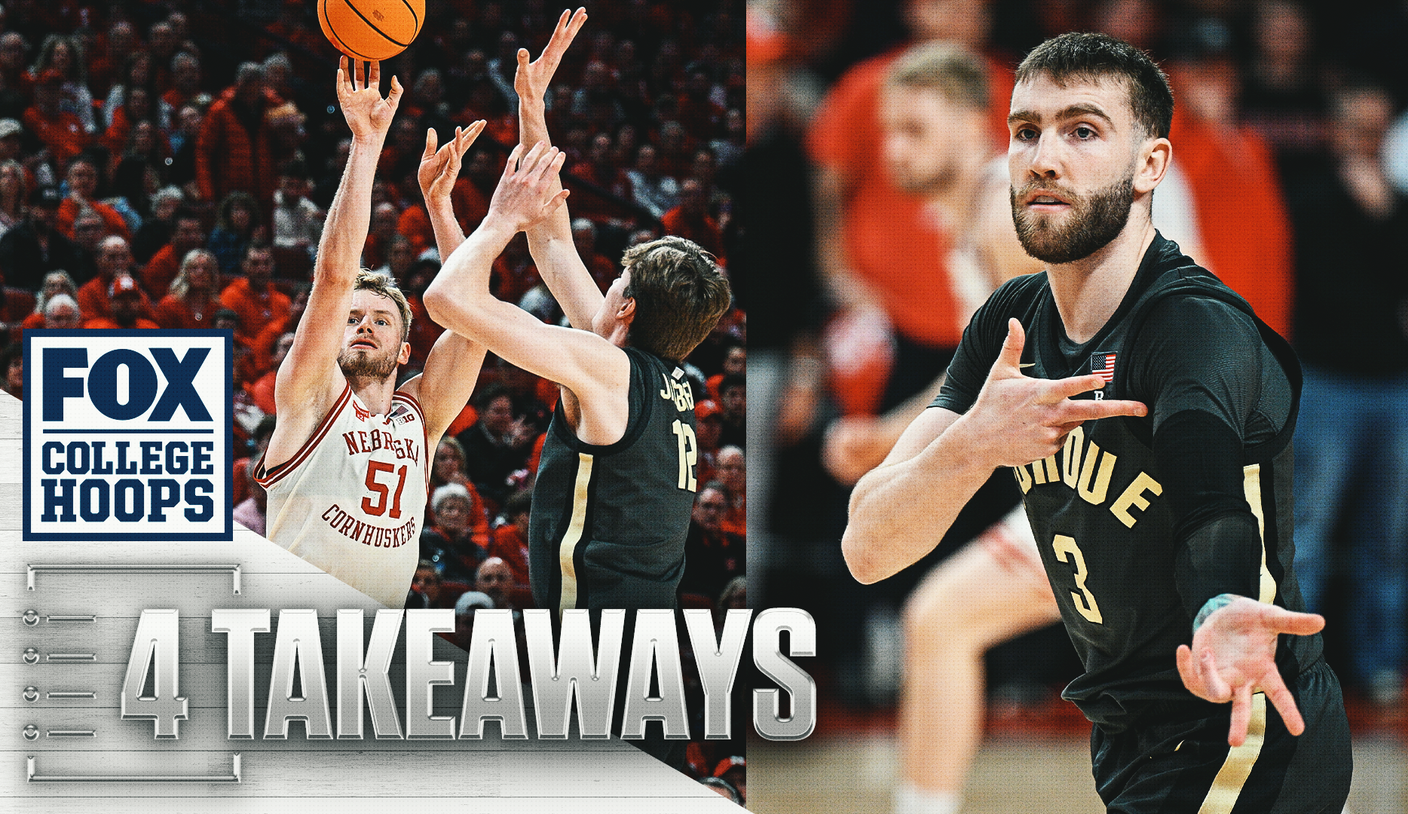
There were moments on Tuesday night, more than Purdue head coach Matt Painter would care to admit, when his team staggered and wobbled following an enthralling first half on the road against No. 7 Nebraska.
A potent blend of relentless offensive rebounding, timely perimeter shooting and the ever-present playmaking from star point guard Braden Smith had propelled No. 5 Purdue to a double-digit advantage that swelled as high as 22 shortly after halftime. And then, amid an avalanche-like closing stretch from the Cornhuskers, the Boilermakers nearly flatlined.
Asleep and adrift to begin the evening, Nebraska roared to life with an extraordinary second-half effort that included seven 3-pointers and a 14-1 run to end regulation and force overtime. The raucous fans at Pinnacle Bank Arena, who deserve credit for not bailing early, reached fever-pitch levels as the Cornhuskers took their first lead of the game in overtime.
But Painter’s recommitment to a starting lineup that had far more size than Nebraska — especially after power forward Rienk Mast fouled out — allowed the Boilermakers to dominate the extra session on the glass, out-rebounding the Cornhuskers by six during that stanza and drawing one critical foul after another. A spinning layup from center Oscar Cluff with 5.2 seconds remaining proved to be the winning basket in an eventual 80-77 victory.
Here are my takeaways:
1. Purdue will influence the Big Ten title race — even if the Boilermakers don’t win it

Prior to Tuesday’s victory, the Boilermakers sat in fifth place in the conference standings behind Michigan State, Nebraska, Illinois and league-leader Michigan. An overtime win over the Cornhuskers vaulted Painter’s team into a tie for third with Nebraska and Michigan State at 10-3 in conference play, a half-game back of Illinois and two games behind the Wolverines.
With less than a month remaining in the regular season, it’s clear that Michigan (22-1, 12-1 Big Ten) remains the overwhelming favorite to win the league under second-year head coach Dusty May. But the nature of Purdue’s remaining schedule, which includes matchups with both the Wolverines and the Spartans, means that Painter and Co. will have a significant say in how the Big Ten race unfolds.
After factoring in a victory over Nebraska, the Boilermakers are now third nationally in offensive efficiency behind only Alabama and Illinois. They are, perhaps, the only team in the league outside of the Illini with enough offensive savvy, execution and perimeter shooting to outduel the Wolverines in what could be a very high-scoring game later this month. At 127.1 points per 100 possessions, this Purdue team is Painter’s most potent since he took over ahead of the 2006 campaign. That alone will give the Boilermakers a chance on any given night against the Big Ten’s best.
So even if Purdue isn’t consistent enough to track down Michigan in the coming weeks — and this current choppy stretch of six games that includes three losses, one blowout victory and two single-digit wins over Oregon and Nebraska certainly invites doubt — there’s no question Purdue is talented enough to potentially snare an upset or two down the stretch.
2. Fletcher Loyer is regaining his early season form for Purdue
There was a seven-game stretch from Jan. 7-27 in which Purdue shooting guard Fletcher Loyer, a career 40.2% shooter from 3-point range, endured a prolonged slump from beyond the arc. He made one or fewer 3s during five of those seven outings — including two games with zero triples — and only made nine of 33 attempts overall for a 27.3% clip. He averaged just 8.4 points per game during that stretch, which was five points below his season average. And, perhaps most importantly, the Boilermakers suffered three consecutive losses against Indiana, then-No. 11 Illinois and UCLA.
But Loyer began emerging from his icy run with a breakthrough 29-point effort in a 93-63 throttling of Maryland earlier this month. He tied a season high that afternoon with seven 3-pointers and made nine of 14 shots from the field overall, falling just a single point shy of the career-best 30 he established in this year’s season opener. Six days later, Loyer chipped in 18 more points — each of them crucial — in a surprisingly narrow home victory over Oregon. Three of Loyer’s four field goals against the Ducks came from 3-point range to extend his renewed perimeter form.
The smoldering shooting followed Loyer into Tuesday’s game at Nebraska, where he buried two more 3-pointers before the first media stoppage to spark a 14-1 start that forced Cornhuskers’ head coach Fred Hoiberg to burn an early timeout. Loyer added three free throws shortly thereafter when a Nebraska defender contested his jump shot too aggressively. And later, with Purdue’s lead continuing to widen, he offered a slight shoulder fake on the wing that invited a closeout and cleared the way for a driving layup in transition.
By halftime, Loyer had scored a game-high 11 points. He finished the evening with a team-high 18 and is now averaging 21.7 points per game over his last three outings.
3. The analytics game is beginning to backfire on Nebraska

From afar, there are many things that coaches around the country admire about Nebraska’s offense, which entered Tuesday ranked 29th nationally in efficiency, according to KenPom. The Cornhuskers employ beautiful off-ball movement, space the floor with multiple perimeter threats, share the basketball at an elite clip and rely heavily on 3-point shooting. Heading into Tuesday night, Texas Tech (41.8%) and Alabama (41.2%) were the only power-conference teams to score a greater percentage of their points from beyond the arc than Nebraska (41.1%).
Hoiberg’s philosophy worked wonders from the beginning of the season through late January, by which time the Cornhuskers were still unbeaten after rattling off 20 consecutive wins, climbing all the way to No. 5 in the AP Poll. Five different players established themselves as legitimate 3-point threats during that remarkable run, headlined by Iowa transfer Pryce Sandfort, a true sharpshooter relying on perimeter jumpers for more than 57% of his field goal attempts. He entered the matchup with Purdue having made multiple 3s in all but three games this season.
But the efficacy of Nebraska’s approach faded significantly in back-to-back losses against then-No. 3 Michigan and then-No. 9 Illinois as January turned to February. An extreme reliance on perimeter shooting transformed the Cornhuskers into a one-dimensional outfit, with opponents largely content to let them fire away from 3-point range. Hoiberg’s team only made 18 shots inside the arc against Michigan and just 10 against Illinois. It didn’t matter that Nebraska buried 25 3-pointers across those two games combined because the offense wasn’t balanced enough to keep pace over 40 minutes.
A similar pattern began to unfold when the Cornhuskers battled Purdue on Tuesday night. Hoiberg’s group made just eight field goals in the opening 20 minutes en route to a 16-point halftime deficit. And only four of those baskets originated inside the arc. The Boilermakers were successfully defending the interior in a way that troubled Nebraska, just as Michigan and Illinois had done before them.
And while Hoiberg’s team reawakened in the second half — making seven of 14 attempts from beyond the arc to reflect just how dangerous these Cornhuskers can be — it was the first-half imbalance that forced Nebraska to lean so heavily on perimeter shooting once the deficit ballooned. The Cornhuskers finished the evening having made only 14 shots inside the arc, tied for their third-fewest in the last 11 games.
4. This version of center Oscar Cluff gives Purdue a new dimension

Oscar Cluff #45 of the Purdue Boilermakers scores against the Nebraska Cornhuskers. (Photo by Steven Branscombe/Getty Images)
For the Boilermakers, their first year of life after Zach Edey — a mountainous 7-foot-4 center and two-time Naismith Men’s College Player of the Year in 2023 and 2024 — came with a distinctly different look at that position. Gone was Edey’s hulking, indomitable frame, replaced by the gentler silhouette of Trey Kaufman-Renn, listed at 6-foot-9 and 230 pounds, more traditional power forward than imposing anchor. The next-tallest player in Purdue’s most-used lineup last season was forward Camden Heide at 6-foot-7, 205 pounds.
In an effort to add more heft ahead of the 2025-26 campaign, Painter identified former South Dakota State and Washington State center Oscar Cluff as a viable option in the transfer portal. At 6-foot-11 and 255 pounds, Cluff represented more of a traditional center in the physical sense. He averaged 17.6 points and 12.3 rebounds for the Jackrabbits last season and would allow Kaufman-Renn to shift back to power forward, with both big men on the floor together for the Boilermakers, surrounded by capable perimeter shooters.
Cluff started the season remarkably well as Purdue, which was picked to win the league for a third consecutive year, began 17-1 overall and 7-0 in the Big Ten. It wasn’t until late January when Cluff’s influence and contributions began to fade: In the five outings prior to Tuesday’s showdown with Nebraska, he averaged just 5.2 points and 3.8 rebounds per game — well below his season averages of 10.7 points and 7.2 rebounds, respectively.
What unfolded at Pinnacle Bank Arena, though, was Cluff’s finest performance since he scored 19 points, grabbed six rebounds and dished out four assists in a victory over USC on Jan. 17. Against an undersized Nebraska frontcourt that lacks a traditional center, Cluff was a menace on the offensive glass. Ten of his 14 rebounds came on the offensive end of the floor on a night when Purdue racked up 17 second-chance points. He also shot an efficient 5-of-9 from the floor, blocked two shots and dished out two assists in a complete showing.
It was exactly the kind of high-level post play the Boilermakers will need alongside Kaufman-Renn (six points, 19 rebounds) in order to make a deep NCAA Tournament run.
4½. What’s next?
The gritty victory over Nebraska marked the beginning of a tricky five-game run for the Boilermakers to close the month of February. A road game at Iowa on Feb. 14 will give way to three consecutive home games against No. 2 Michigan, archrival Indiana and No. 10 Michigan State, with the results from that stretch dictating Purdue’s trajectory entering March. What looks like a friendly finishing kick against Ohio State (away), Northwestern (away) and Wisconsin (home) should allow Painter’s team to stabilize before the Big Ten Tournament if things go awry between now and then.
The path forward appears significantly more manageable for Nebraska, which should benefit from a remaining strength of schedule that ranked 63rd nationally and 14th in the Big Ten entering Tuesday’s game. None of the Cornhuskers’ forthcoming opponents between now and the conference tournament appeared in the latest version of the AP Poll, with three of the seven owning league records well below .500. There’s a real chance for Hoiberg and his team to enter March Madness on an upward swing if Nebraska can bounce back from Tuesday’s loss.
Discover more from stock updates now
Subscribe to get the latest posts sent to your email.